


“Do it from the heart”: Former NUS Board member Edward D’Silva on shaping public hygiene and serving the community
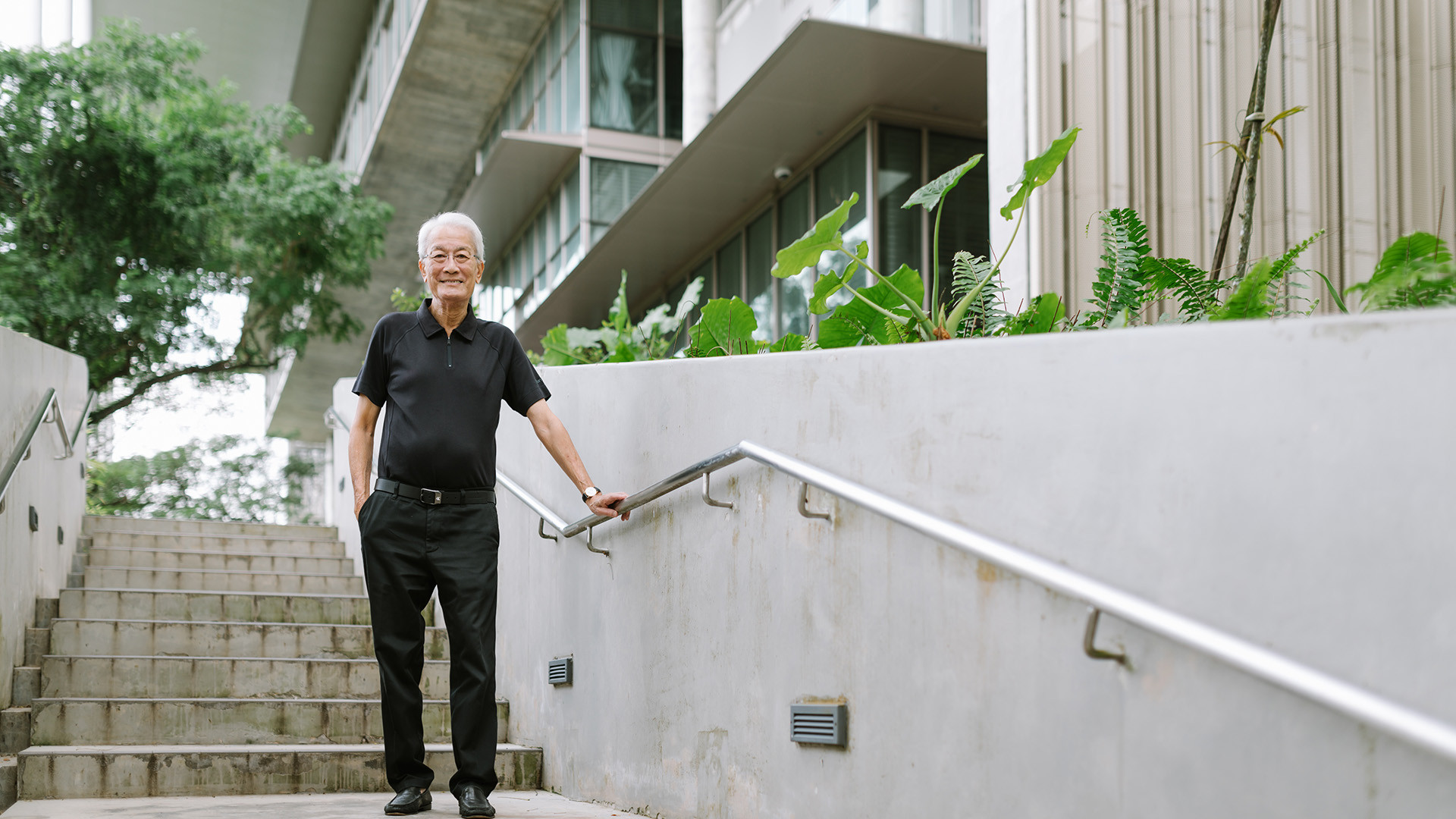
Singapore has a reputation around the world for being squeaky clean, but a lot more needs to be done to make its people realise that keeping it clean is everyone’s business and not just the job of the nation’s cleaners. Just ask Mr Edward D’Silva, former chairman of the Public Hygiene Council.
“I remember going on litter-picking rounds,” recalls Mr D’Silva of the time he walked around a hawker centre and passed by a group of elderly men seated at a table who thought he was there to perform the Corrective Work Order – the regime where litterbugs are made to clean up the community. It dawned on him then that it was necessary to change the mindset that clearing litter was only the responsibility of those penalised for littering or paid to do so. “That’s when I realised: we still have a long way to go to educate the typical Singaporean,” said the 73-year-old.
As the hygiene council’s longest-serving chairman from 2015 to 2023, he spearheaded efforts to get Singaporeans to pick up litter, return their dining trays at food centres, and keep public toilets clean. For those contributions and more, he was awarded the prestigious Meritorious Service Medal at the 2024 National Day Awards, after receiving a Public Service Star in 2018 and Public Service Medal in 2014.
Singaporeans must take ownership of public hygiene, stressed Mr D’Silva, who joined the council as a member in 2013. His concern about a lax attitude toward public cleanliness compelled him to get involved.
“There were too many cleaners, so everybody started to take it for granted,” he explained. Unattended food trays in hawker centres attract birds and other pests, but simply telling people to return their trays did not work, he observed. In September 2021, measures against diners who fail to clear their used trays and crockery at hawker centres – including fines for repeat offenders – were imposed by the National Environment Agency and Singapore Food Agency. These measures were later implemented at coffee shops and food courts in January 2022.
Remarking on the moves which came at the tail-end of the pandemic, Mr D’Silva said, “(COVID-19) was the best time to implement this,” noting that people had grown accustomed to following official health measures and were more aware of the importance of good hygiene in curbing the spread of diseases.
Yet, improving public hygiene is a long-term journey, one that begins with nurturing these values at a young age. This is why initiatives such as the Keep Singapore Clean Movement in Schools – launched by the Ministry of Education and supported by the council to encourage students to take ownership of their schools’ cleanliness – are especially important.
“I hope that in 10 to 20 years’ time, we will see the younger generation having more civic consciousness to keep Singapore clean,” he added. “We have moved towards a good mindset shift on littering and tray returns – it’s becoming more of a natural habit for (Singaporeans) to return their trays. The next step is having clean public toilets.”
Man with a plan
Mr D’Silva is not only an advocate for public hygiene, but an architect by profession. After enrolling in Architecture at NUS in the 1970s, he joined the Urban Redevelopment Authority (URA) as a planner, where he was involved in land use plans for Marina Centre in downtown Singapore.
After eight years at URA, he joined SAA Architects and spearheaded the homegrown firm’s foray into Vietnam, Cambodia, and Myanmar in the 1990s, where it designed serviced apartments. He also oversaw developments in India, such as IT parks and residences, and helped secure major projects like the Four Seasons Hotel Singapore.
What advice does he have for young architects? “They have to have two things,” said the former president of the Singapore Institute of Architects and current senior advisor at SAA Architects. “Apart from a flair for design, (they need) a flair for communications – that is very underestimated.”
World-renowned architects did not just share sketches with clients, they also shared a story, he noted. This emphasis on equipping Architecture students with communication and critical thinking skills was something he advocated for during his time on the NUS Board.
He also started the Edward D’Silva Award in 2007 to support travel and research expenses for final-year students of the NUS Master of Architecture programme at the Department of Architecture. “I said, if I could give one student a year at least the opportunity to go overseas, and see what’s happening (elsewhere in the world), that’s something I would find very gratifying,” recalled Mr D’Silva, who served on the NUS Board of Trustees from 2003 to 2014 and the NUS Alumni Advisory Board from May 2014 until June this year. He was a recipient of the NUS Distinguished Alumni Service Award in 2015.
Giving back to the community
Through the years, he has sat on numerous boards across a range of sectors, from the National Institute of Education, Strata Titles Boards and Prison Fellowship Singapore to the Public Service Commission, where he interviewed prospective scholarship recipients.
“Many of them had good grades but no general knowledge. I remembered asking (one scholarship candidate) about Singapore’s domestic affairs. He didn’t know who the chief justice was, and that guy wanted to be a lawyer!” he recounted with a chuckle. “Over time, we realised that we needed to approach the junior colleges and promote awareness among potential candidates (of what was required).” Realising that many young scholars had little ground knowledge after returning from their overseas studies, he recommended that they do operational postings in various frontline agencies.
Today, he remains active in the community. A glance at his CV will reveal a long list of appointments, such as District Councillor of Central Singapore Community Development Council, Trustee of the Eurasian Association, member of the Reformative Training Centre Review Committee, Board of Visiting Justices, and the boards of Singapore Anglican Community Services and Singapore Ballet.
He shows no sign of slowing down. What keeps him going is a personal maxim that he gladly shares: “Whatever you do, do it from the heart.”
