


NUS Computing Gallery showcases the bits and bytes of Singapore’s IT history
Every computer programmer will know the frustration of seeing an error message after executing their code. But this is a more recent angst.
More than four decades ago, programmers would have been delighted to get such instant results – error or otherwise – because operating a computer in those days was slow and tedious.
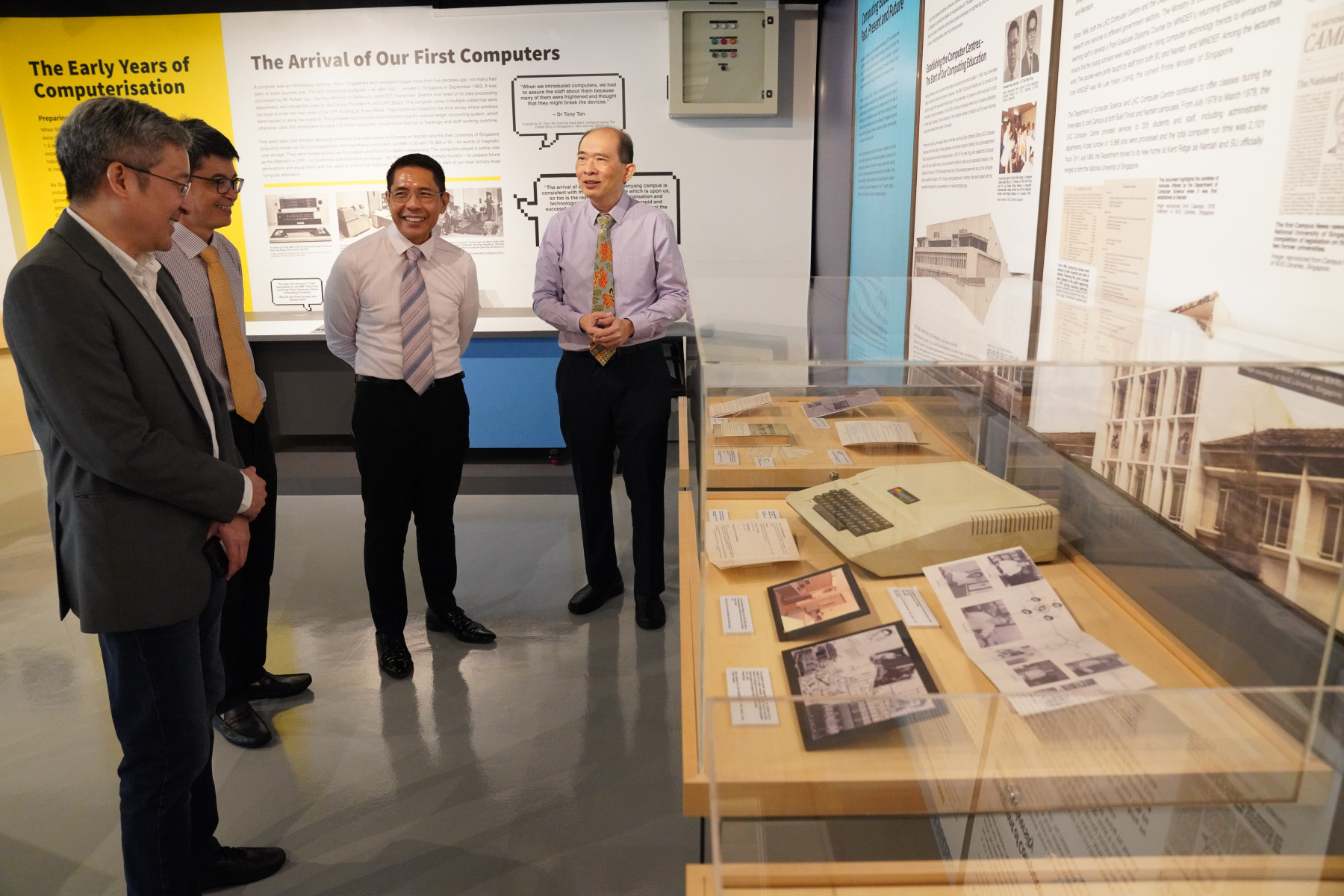
Back then, programmers had to “write” their code by punching holes on a card manually using a keypunch machine. One statement per card. A computer program would thus consist of a stack of cards, which was then given to a human operator to feed into the machine, such as the IBM 1130, a 1960s computer widely used in academia. And since many programmers used the same machine, you had to wait a day to get your results. A replica of the IBM 1130, with its punch cards, is on display at the National University of Singapore (NUS) Computing Gallery, officially launched by Dr Maliki Osman, Minister, Prime Minister’s Office, and Second Minister for Education and Foreign Affairs on 20 May.
Open to the public and located in the NUS School of Computing’s (NUS Computing) oldest building, COM 1, the gallery is the first of its kind in Singapore and in Southeast Asia. Comprising about 100 artefacts, it showcases the history of information technology and the evolution of computing education in the country.
Recalling the old and slow way of programming, Associate Professor Tan Sun Teck, who was among the third cohort of locally-trained computing graduates, explained that a single mistake in your code meant having to redo everything and waiting for another day. Each card cost a cent, so the more mistakes made, the more costly a project was – in terms of time, money, and effort.
“The process was very tedious,” said Assoc Prof Tan from the Department of Computer Science at NUS Computing who completed his Bachelor of Science in Computer Science and Mathematics at Nanyang University in 1980, before its merger with the University of Singapore to form NUS.
“We had to be very careful – we put in a lot of effort to design computer programs, run through all possible scenarios, and anticipate problems even before we ran the program.” This skill serves Assoc Prof Tan well even to this day.
Apart from the IBM 1130, other artefacts on display at the NUS Computing Gallery include computers, hard disk drives, and even old textbooks.
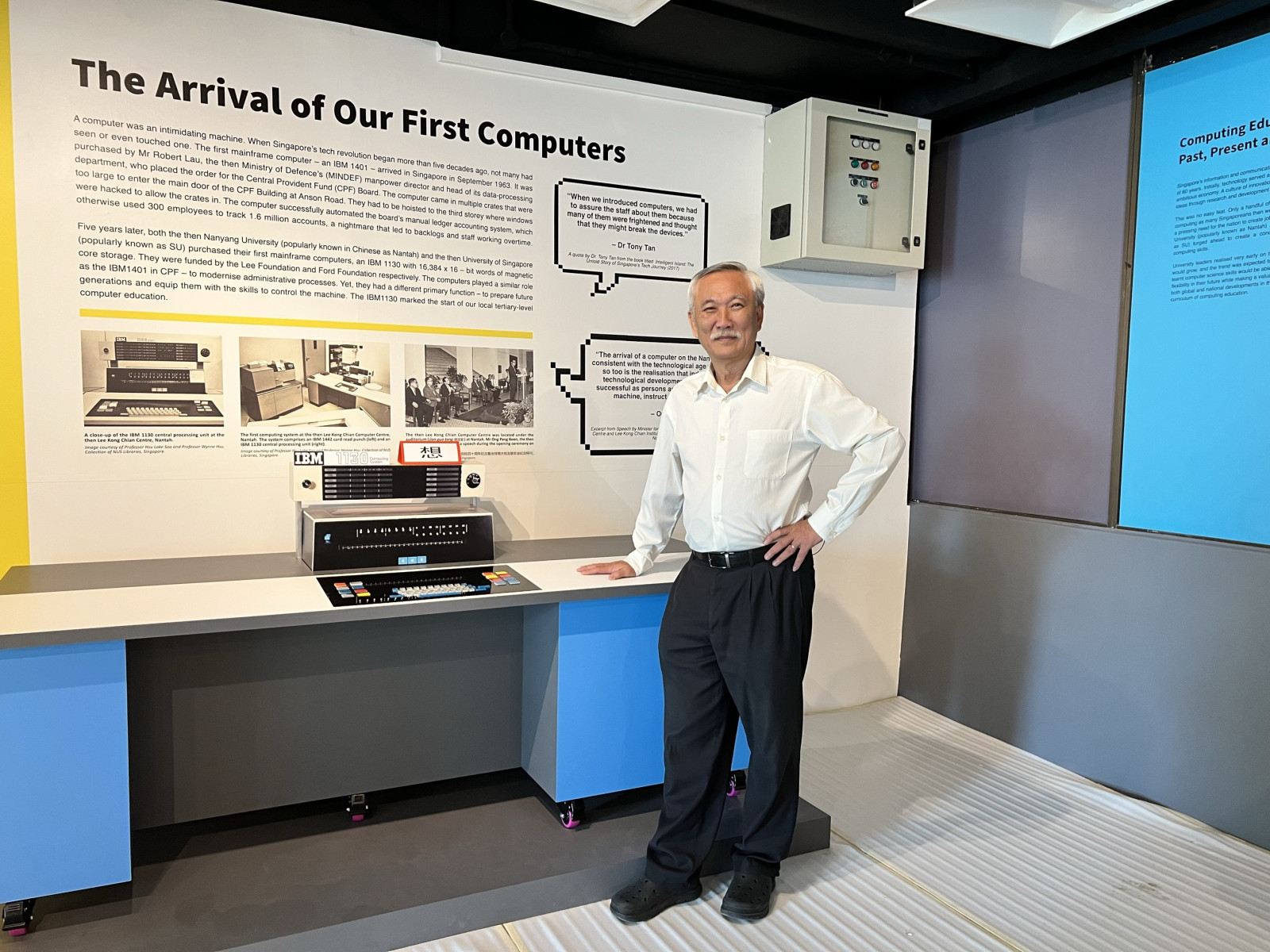
Nostalgic treasures
The idea for the Gallery came to Associate Professor Terence Sim, its Director, back in 2018, when the school created a historical display to commemorate its 20th anniversary.
“With hardware going obsolete so quickly, NUS Computing has a lot of old equipment. I thought that instead of taking up storage space, we should just turn them into an exhibition,” he said. “We see it as part of our education mission.”
Partnering with NUS Libraries was crucial. “Thankfully, they came on board with us,” Assoc Prof Sim added. They not only combed through the national archives, but also conducted interviews with pioneers from the early days of IT in Singapore, he added.
The artefacts in the 120-sqm space are organised according to three themes – historical, education, and industry. While some items had to be bought, most were donated by NUS staff, professors, students, and alumni.
Ten of them came from Assoc Prof Tan’s office alone. “My office could become another computing museum,” he joked. “After 40 years at NUS, I have accumulated a lot of old things.”
Besides the punched cards used with the IBM 1130, one of the items from Assoc Prof Tan’s treasured collection is the device that introduced the graphical user interface to Apple computers – the Apple Macintosh. As a PhD student in England in 1985, Assoc Prof Tan spent a few thousand dollars to buy the machine and has not parted with it since.
The Gallery also showcases the evolution of external storage devices – from large floppy disks and tape cartridges to zip disks and thumb drives – and documents oral histories from IT pioneers such as Emeritus Professor Bernard Tan Tiong Gie. He was the proud recipient of the first BITNET email message sent to Singapore from the United States in 1987, which successfully linked NUS to the international networking community, and also put Singapore on the path of Internet connectivity.
“The NUS Computing Gallery is more than just a display of historical information and a collection of artefacts. It is an acknowledgment of brilliant minds and a reminder of how far we have accomplished in the technology realm. Each artefact has a story to tell – it reflects the ingenuity and creativity of great innovators and architects of technology who have persevered and contributed to the digital world we live in presently,” said Professor Tan Kian Lee, Dean of NUS Computing.
“This initiative underscores the School’s and the University’s commitment to Singapore’s technological legacy, and commemorates the remarkable growth and accomplishments in computing education and IT over the decades,” he added.

Computing is for everyone
Assoc Prof Tan hopes the exhibition will help people better appreciate the rich history of computing and understand not only how far Singapore has come, but also how fast it has progressed.
He also hopes it will show current computing students that the field has a great impact on society. He explained, “They are the future generation. They will develop and improve on what we have through innovation and research.”
With computing’s ubiquitous influence on the world, Assoc Prof Sim highlights that a basic understanding of computing must be part of general education, in much the same way that every child needs to learn reading, writing, and arithmetic.
He hopes the NUS Computing Gallery will help dispel the common misconception that computing is only about programming. He compared it to studying mathematics in school. The equations are not the biggest takeaways, he said. Instead, the key is to cultivate a computational way of problem solving.
“Computational thinking, rather than programming, needs to be taught to everybody,” he added.
The NUS Computing Gallery opens from Tuesdays to Thursdays, 11 am to 5 pm, and admission is free. More information on the Gallery is available at comgallery.nus.edu.sg/.
Please refer to the press release here, and the list of exhibits here.
