


NUS Sustainability Academy: Driving Singapore’s green skills development and educating future generations

In this series, NUS News explores how NUS is accelerating sustainability research and education in response to climate change challenges, and harnessing the knowledge and creativity of our people to pave the way to a greener future for all.
In 2022, the NUS Sustainability Academy was established with the aim of nurturing Singapore's green talent pipeline. Now in its fourth year, it outlines its upcoming plans for 2026, including a new learning journey for Institute of Technical Education students to prepare them for the green economy, and courses aimed at training overseas government officials to build capacity in carbon markets and blue carbon ecosystem management.
In line with Singapore’s growing demand for a skilled green workforce, the NUS Sustainability Academy – a collaborative effort between NUS Sustainable Futures and the NUS School of Continuing and Lifelong Education – curates and develops a range of 13 continuing education and training (CET) courses from across the University. Through hands-on living labs and an integrated curriculum, these courses are designed to upskill professionals and educate future generations to take on future sustainability challenges.
Beyond its national upskilling efforts, the Academy also aims to be a leading force in regional climate action by fostering interdisciplinary research for tropical and urban solutions.
Launched in 2022 under the CET Pillar of the NUS Centre for Nature-based Solutions (CNCS), the Academy was founded to translate research into practice and action by cultivating a green talent pipeline, as envisioned in the Singapore Green Plan 2030. Its integration with NUS Sustainable Futures in May 2025 further refined its mission. It now serves as the University’s central hub for sustainability-related lifelong learning programmes, delivering practical, workplace-oriented education that addresses key capability gaps and connects learners to vital industry networks.
This commitment to actionable change underpins the Academy’s approach. Ms Melissa Low, Head of the NUS Sustainability Academy, said, “As individuals and members of the University, local and global communities, it is our responsibility to address the climate crisis through a combination of institutional change advocacy, supporting systemic solutions through research and application, as well as community engagement and personal actions. Through the sharing by NUS faculty and researchers on their latest findings with participants at the courses that we offer, the Academy bridges the gap between research and industry through workplace training programmes.”
Translating knowledge into practice, driving meaningful change
In 2025, the Academy ran a total of 13 courses and trained close to 350 participants from the public sector, industry, non-governmental organisations, and members of the public – an increase from just four courses in its first full year of operations. Since inception, 614 learners have attended the programmes which are curated by the Academy.
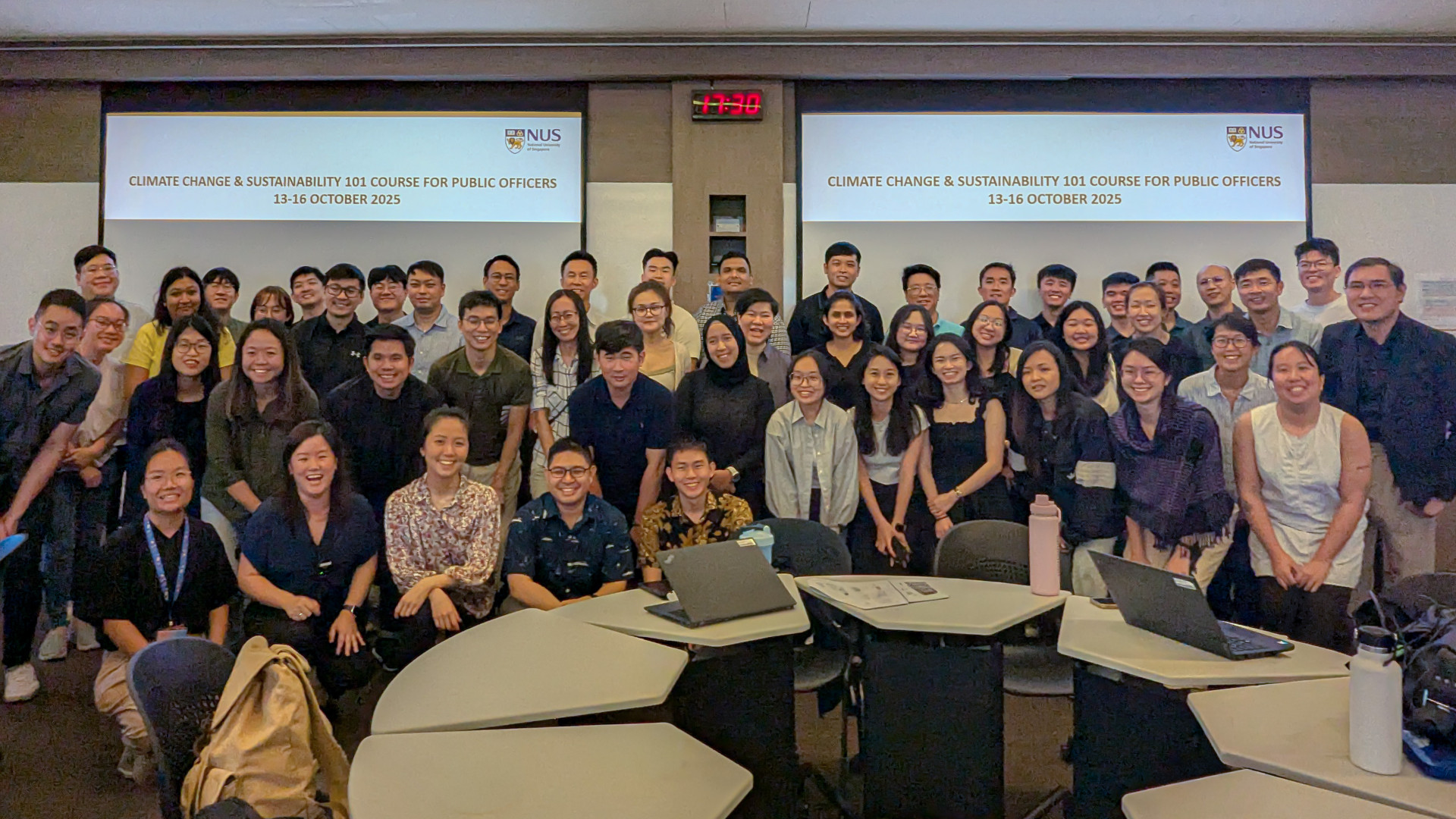
Among the courses is the “Climate Change and Sustainability 101 Course for Public Officers”, which has now become a recognised primer for government agencies. The programme equips policy officers with a common language and the capabilities to understand international developments and their impact on Singapore, identify sustainability trends, and confidently develop sustainable policies in their domain. Designed in 2022 in close collaboration with the National Climate Change Secretariat and the Ministry of Sustainability and the Environment, the course is aligned with the Inter-Ministerial Committee on Climate Change’s Competencies Framework. Following a curriculum review in 2024, it was expanded to include topics on green supply chain and procurement, water sustainability as well as waste recycling.
The Academy also launched the “Professional Carbon Certificate in Carbon Services and Trading” in May 2025, to equip practitioners with competencies in carbon project development while convening a trusted community of practice. To date, the course has trained over 110 professionals to help Singapore realise its ambition of becoming a carbon services and trading hub. The programme was developed in collaboration with industry professionals and government agencies such as the Singapore Economic Development Board and Enterprise Singapore.
Fostering green citizenry beyond Singapore
Extending its outreach, the Academy has also been awarded by the Ministry of Foreign Affairs under its Singapore Cooperation Programme and the Singapore Cooperation Enterprise to conduct capacity-building programmes for overseas government officials. An inaugural batch of 21 overseas government officials from across 17 countries attended the “Nature-based Carbon Project Development and Measurement, Reporting and Verification” programme that was curated by the Academy, in February 2025.
Further demonstrating its global reach, the Academy hosted a delegation of five participants for an “Article 6 Implementation Capacity Building (AICB) for African nations” learning journey in August 2025. Participants visited the Sungei Buloh Wetland Reserve to assess the site’s hypothetical potential as a project under the Verified Carbon Standard, a benchmark for certifying carbon credits to offset emissions.
Article 6 of the 2015 Paris Agreement creates a framework for international cooperation on climate action, primarily through market-based carbon trading and non-market approaches to help countries meet their Nationally Determined Contributions.
The learning journey also showcased the Sungei Buloh Wetland Reserve’s history and its importance to Singapore’s society and natural heritage, with research facilitators from the Academy, CNCS and the NUS Climate Governance of Nature-based Carbon Sinks in Southeast Asia (CGSEA) project introducing mangrove science, morphology, and ecosystem dynamics. Participants explored the ecosystem services that mangroves provide – coastal protection, biodiversity support (including habitats for migratory birds and nurseries for fish), ecotourism, and carbon storage – and examined why mangroves are under the spotlight for climate mitigation.
Looking ahead, the Academy is set to expand its educational offerings in 2026, having been awarded by the Ministry of Foreign Affairs to deliver two new programmes. These include the “Article 6 Implementation on a National Basis” course from 9-13 February 2026 and “The State of Blue Carbon Science, Policy and Finance for Small Island Developing States” course from 23-27 March 2026. The courses will explore how nations can implement the comprehensive requirements of Article 6 of the Paris Agreement effectively and realistically, and enhance participants’ understanding of the science, policy and financing tools available to conserve and restore coastal blue carbon ecosystems in the region.
“These programmes offered by NUS are a response to the urgency of the climate crisis. Across the University, the number of sustainability-themed courses have grown significantly, spanning diverse fields from meteorology and climate science, to green finance and data science for sustainability. NUS has fundamentally shifted its approach to prioritise interdisciplinary education and mission-driven research focused explicitly on developing solutions for climate change mitigation and adaptation,” added Ms Low.
By NUS Sustainability Academy
For more information, please browse the Academy’s Annual Report for 2025 and its lineup of courses for 2026.
