


The π behind MRI: NUS Asst Prof Lei Li models heart function with mathematical precision
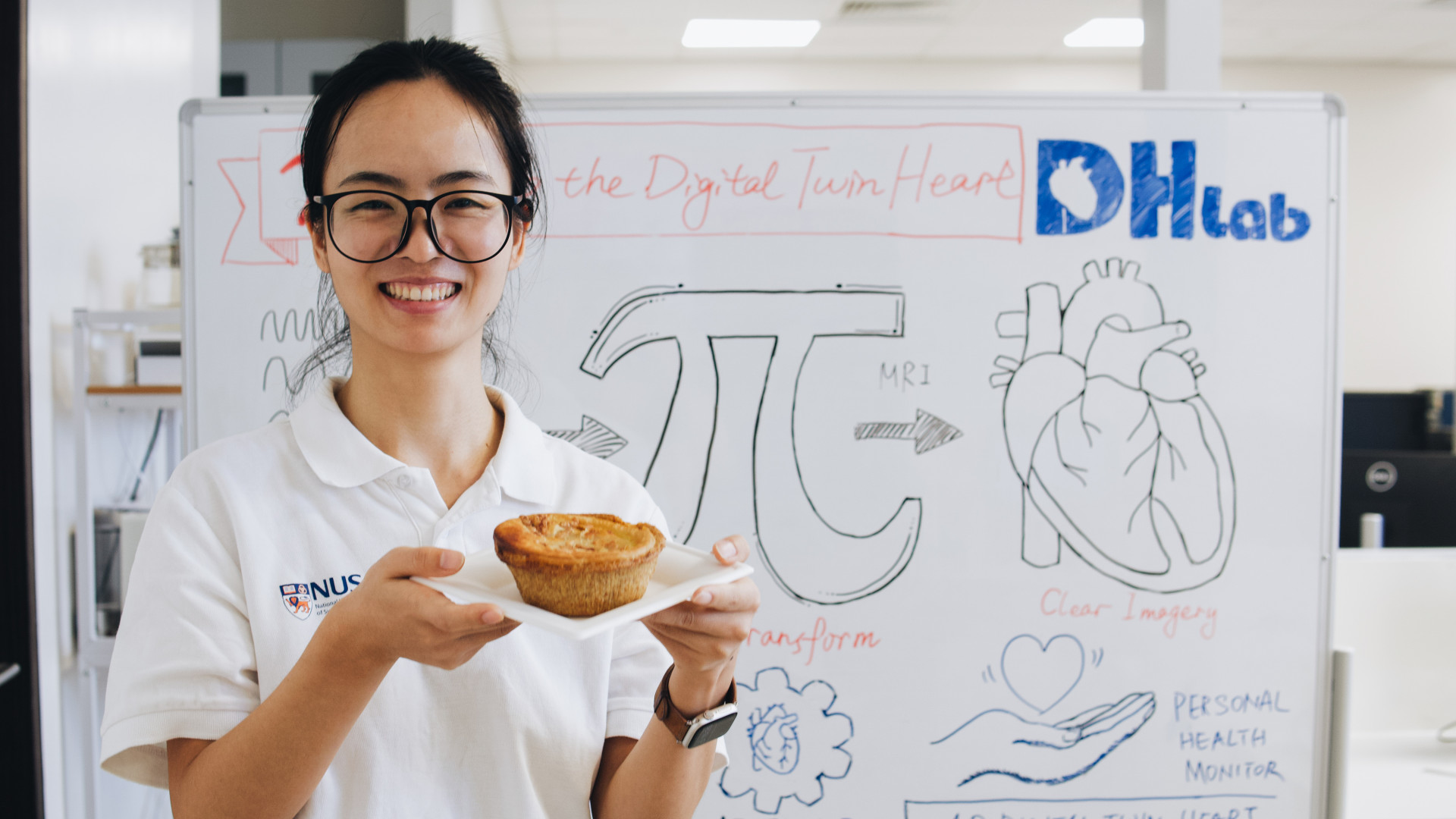
Pi Day falls annually on 14 March, or 3.14. Many people often associate π with math classes, yet it is fundamental across science and engineering. For Assistant Professor Lei Li, Principal Investigator of the Digital Heart Lab under the Department of Biomedical Engineering in the College of Design and Engineering at NUS, π underpins her daily research, shaping how the human body is visualised, through medical imaging and artificial intelligence (AI).
Asst Prof Li develops physics-informed AI systems that use medical imaging data to build personalised digital models of the human heart. Her work focuses on translating mathematical theory into clinical value, linking abstract equations with practical decisions in diagnosis and treatment.
At the centre of this translation is magnetic resonance imaging (MRI), one of the most widely used tools in modern healthcare.
From raw signals to readable images

Unlike a camera, an MRI scanner does not snap a photograph. During a scan, tissues respond to magnetic fields and emit electromagnetic signals. The MRI machine records a stream of signals, and their frequency and timing (phase) tell the scanner where each signal comes from.
To convert these signals into images, MRI systems use a mathematical method known as the Fourier transform. The process separates complex signals into frequency components and recombines them to determine where the signals originated in space. π appears directly in the equations linking frequency, phase and periodicity, making it essential to accurate reconstruction. The consistency and precision of MRI depend on these stable mathematical foundations.
Each scan therefore involves large volumes of real-time computation, from signal capture and position mapping to image reconstruction and refinement.
In the future, as MRI expands beyond static anatomy towards functional imaging — such as measuring blood flow, tissue motion and cardiac mechanics — mathematics increasingly supports the understanding how the body functions, not just what it looks like.
The hidden mathematical complexity behind every scan
Although MRI is now a routine clinical tool, much of its complexity remains invisible to patients. Every scan involves extensive mathematical computation performed in real time. This rigour contributes directly to MRI’s safety, stability and repeatability.
As imaging technologies evolve to include higher resolution scans and more advanced functional measurements, mathematical reliability becomes even more critical, linking mathematics with engineering and medicine, linking theoretical foundations with clinical practice.
Where mathematics drive AI innovation in medicine
While π underpins image formation, Asst Prof Li’s research focuses on how MRI data can be interpreted more intelligently using AI.
Instead of treating AI models as black boxes, her team designs algorithms that reflect the physics and geometry of image formation, including spatial continuity, motion consistency and physical constraints. For MRI scans, this makes the results easier to interpret and less prone to erratic predictions across patients and scan settings.
“Our goal is not for AI to replace mathematics,” Asst Prof Li said. “Our AI algorithms build on imaging theory and mathematical modelling to translate image data with interpretable markers of heart function.”
A key focus of Asst Prof Li’s lab is the development of cardiac digital twins — patient-specific virtual heart models that integrate MRI data with electrophysiology, biomechanics and blood flow. These models treat the heart as a dynamic system rather than a collection of static images. Mathematical constants such as π naturally arise in geometric measurements, wave propagation and fluid dynamics within these simulations.
As research advances, personalised digital hearts could allow clinicians to simulate disease progression, assess patient-specific risks and test treatment strategies before medical intervention.
π still matters
As imaging datasets grow and AI models become more sophisticated, stable mathematical frameworks remain essential. Mathematics provides a shared language connecting imaging hardware, reconstruction algorithms and intelligent analysis tools.
“Higher resolution imaging and more advanced AI all depend on having a reliable mathematical backbone,” Asst Prof Li explained. “Constants like π represent a stable scientific framework that continues to support new technologies.”
On Pi Day, the role of π inside every MRI scan offers a reminder that fundamental mathematics quietly underpins everyday healthcare — enabling clinicians to see inside the body and powering research on the next generation of intelligent medical tools.
