Singapore’s rule of law is not a ‘finished achievement’: Chief Justice Sundaresh Menon calls on future legal custodians to shape its next chapter
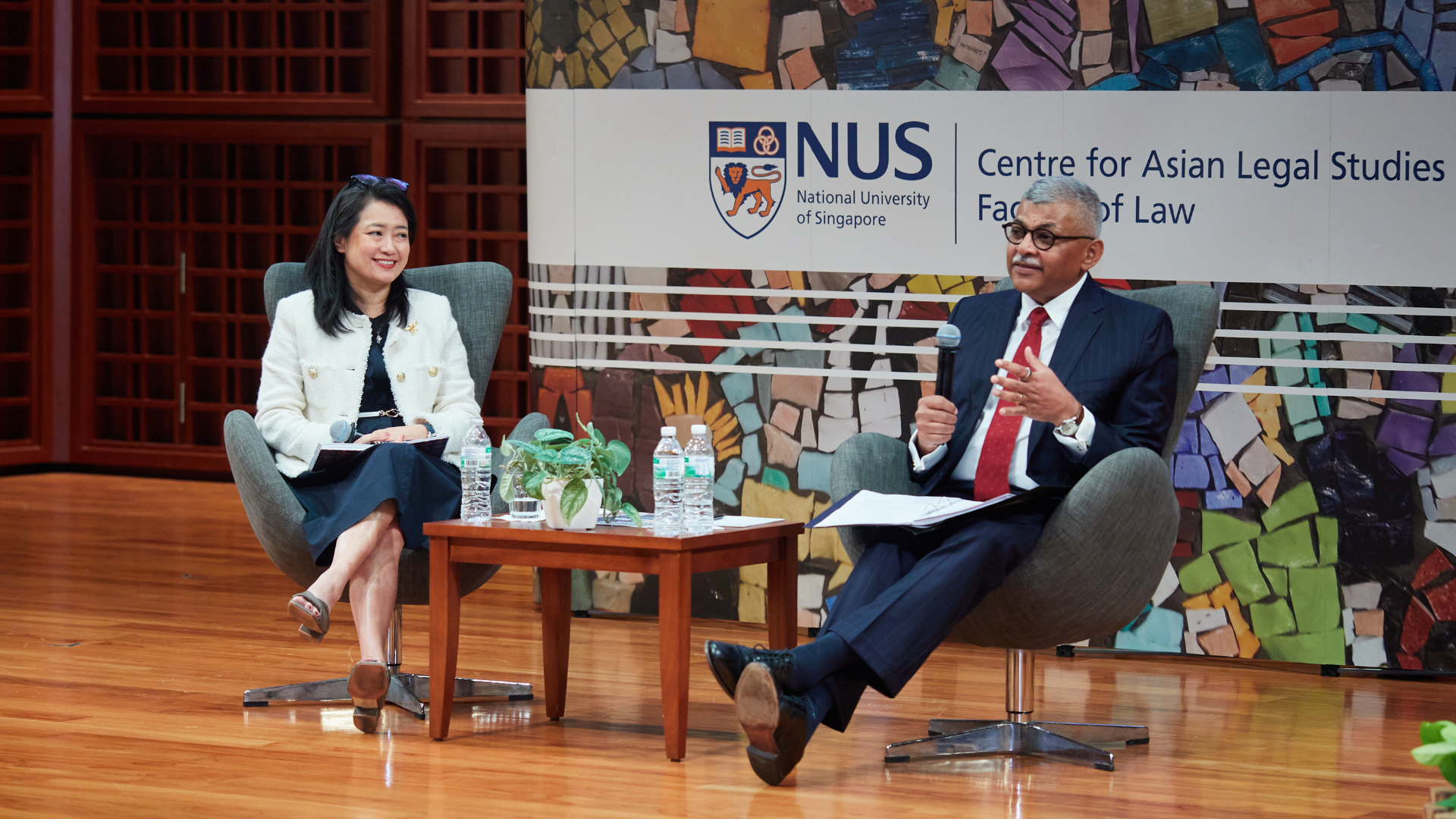
The rule of law must continue to evolve as society and technology change, with lawyers, academics and students playing an important role in shaping the legal system of the future, Chief Justice Sundaresh Menon said at the recent NUS Law Bicentennial Lecture.
“If the rule of law is judged by what it delivers, it cannot ever be regarded as a finished achievement,” said Chief Justice Menon, addressing an audience of about 160 practitioners, policymakers, academics and researchers, students and members of the public at NUS Law on 2 September 2026.
“When changing conditions threaten the legal system’s capacity to deliver justice, certainty, equality and trust, our understanding of what the rule of law requires must evolve in response.”
Hosted by NUS Law’s Centre for Asian Legal Studies (CALS), the hour-long lecture, titled “Evolving Conceptions of the Rule of Law: The Singapore Experience”, was held as part of NUS Law’s commemoration of 200 years of Singapore’s modern legal system, a milestone that dates to the Second Charter of Justice in 1826.
Evolving with the times
Chief Justice Menon traced how Singapore’s legal institutions developed in response to practical needs, from establishing a common and ascertainable body of law and building an independent, effective judiciary, to strengthening accountability and equality before the law.
The legal order has never been static. “Enduring principles may require new expression as the community and the circumstances they serve change,” he said.
He cited the repeal of Section 377A as an example of how law may need to respond as societal values and norms change, while enduring principles remain. He also highlighted four contemporary challenges that could threaten the rule of law’s ability to deliver justice: growing complexity and escalating legal costs; borderless problems such as climate change; pressures on the sustainability of legal practice; and generative AI.
On AI, Chief Justice Menon said it could make the work of lawyers and judges more efficient, but it might also erode trust if used without care.
“The critical distinction is between assistance and responsibility,” he said. AI may assist with identifying, organising and testing material and research. However, “the judge must remain responsible for the decision, the lawyer for the submission, and the institution for the system it chooses to deploy”.
The role of universities and future lawyers
The final part of the lecture was devoted to the people who will help sustain and shape the legal system — lawyers, academics and students — highlighting the responsibilities that each carries in renewing the rule of law.
He said academics contribute by bringing theoretical and doctrinal discipline, analytical rigour and comparative perspectives to the work of judges and advocates, pointing to the work of the Asian Business Law Institute where academics have collaborated with judges and practitioners to develop principles and frameworks for level convergence.
To the students in the audience, Chief Justice Menon said, “You are the future custodians of Singapore’s legal institutions.” He encouraged them to begin taking on that responsibility before entering legal practice, including through legal clinics and pro bono service, where they can see the gap that can sometimes exist between rights on paper and justice in practice.
Students should also resist the instinct to regard any legal system, including Singapore’s, as complete in itself, and instead learn from other traditions, test assumptions and remain willing to ask how institutions might better serve those who depend on them.
Above all, Chief Justice Menon called on students to cultivate integrity and judgement from the outset of their education.
He said, “Professional character is not acquired only upon admission to the Bar; it is formed through your appreciation of and devotion to the mission of the law, and by the choices you will make in your approach to your education, from the honesty of your work, to the care with which you use new technologies, the respect you show to others and your willingness to take responsibility for mistakes.”
Decoding the Second Charter of Justice
The lecture was followed by the launch of Professor Kevin YL Tan’s book, The Second Charter of Justice: A Documentary History. It traces the development, implementation and influence of the Charter, with a clause-by-clause annotation to make the foundational document more accessible to modern readers.
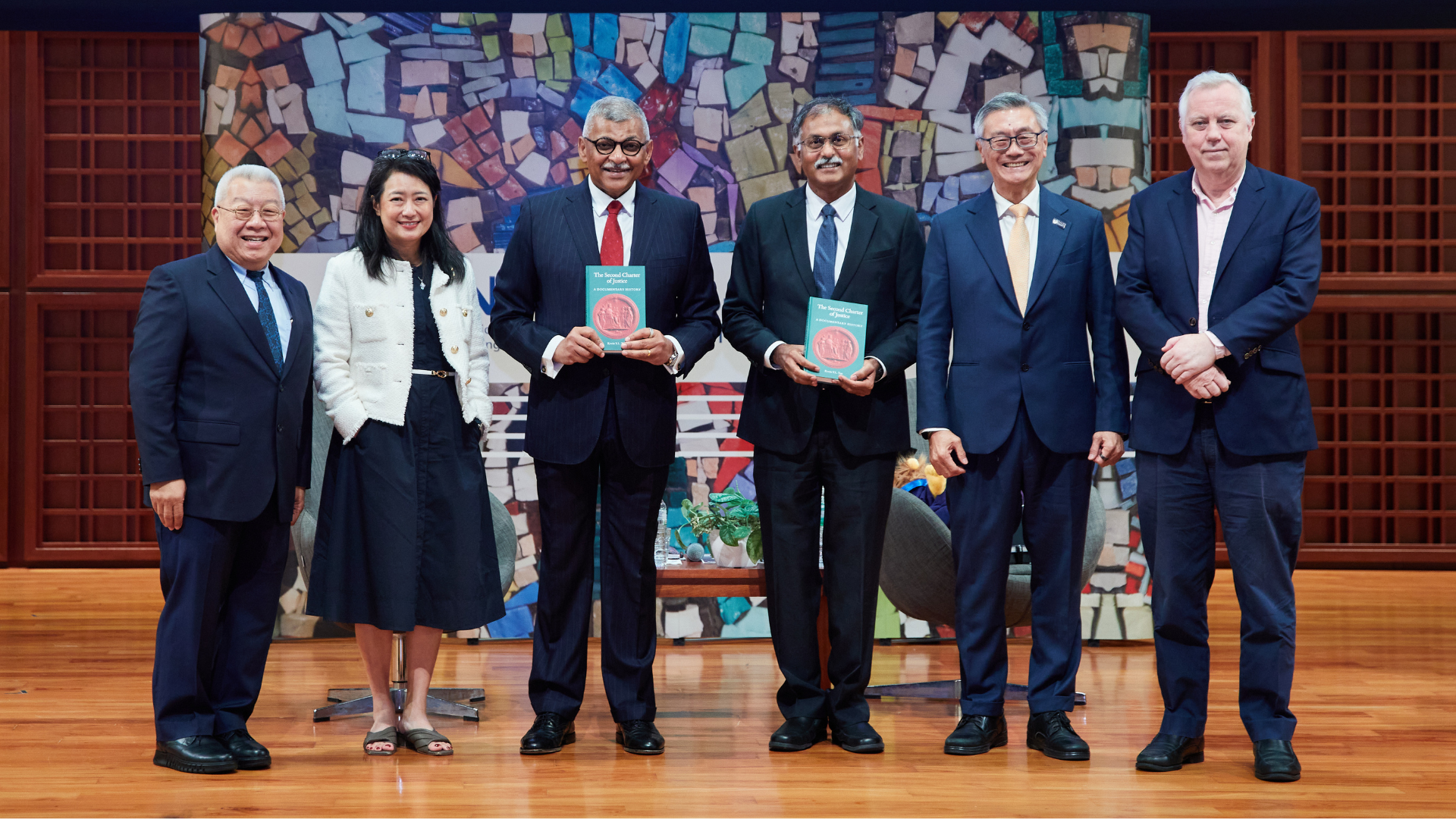
Prof Tan, an Adjunct Professor at NUS Law, said, “The Second Charter of Justice is Singapore’s historically most significant legal instrument. But like so many other celebrated founding texts, it suffers from a familiar fate: it is more frequently cited and referred to than read”, drawing laughter from the crowd.
The document is revered as Singapore’s constitutional “Big Bang” that introduced English common law to its shores. But he noted: “I don’t think anybody alive has ever seen what the (original) Second Charter of Justice looks like.”
Chief Justice Menon, who was Prof Tan’s classmate at NUS Law, said the Charter remains foundational, but it was never the final word — and that is an enduring lesson of its history.
“No legal system arrives fully formed,” he said, nor does it remain unchanged.
For lawyers, academics and students who will shape Singapore’s legal system in the years ahead, the responsibility is to build on that inheritance, strengthening and renewing the rule of law as society’s needs evolve.