


Uncovering hidden stories behind cultural treasures through advanced technologies
Accelerator-based and advanced analytical techniques are shedding new light on the materials and preservation needs of important artefacts from around the world.

When we walk through a museum, we often marvel at the beauty, uniqueness, or exquisite craftsmanship of treasured artefacts, each with its own story to tell. But what if we could go deeper – beyond what the eye can see – to understand how these objects were made and the materials used?
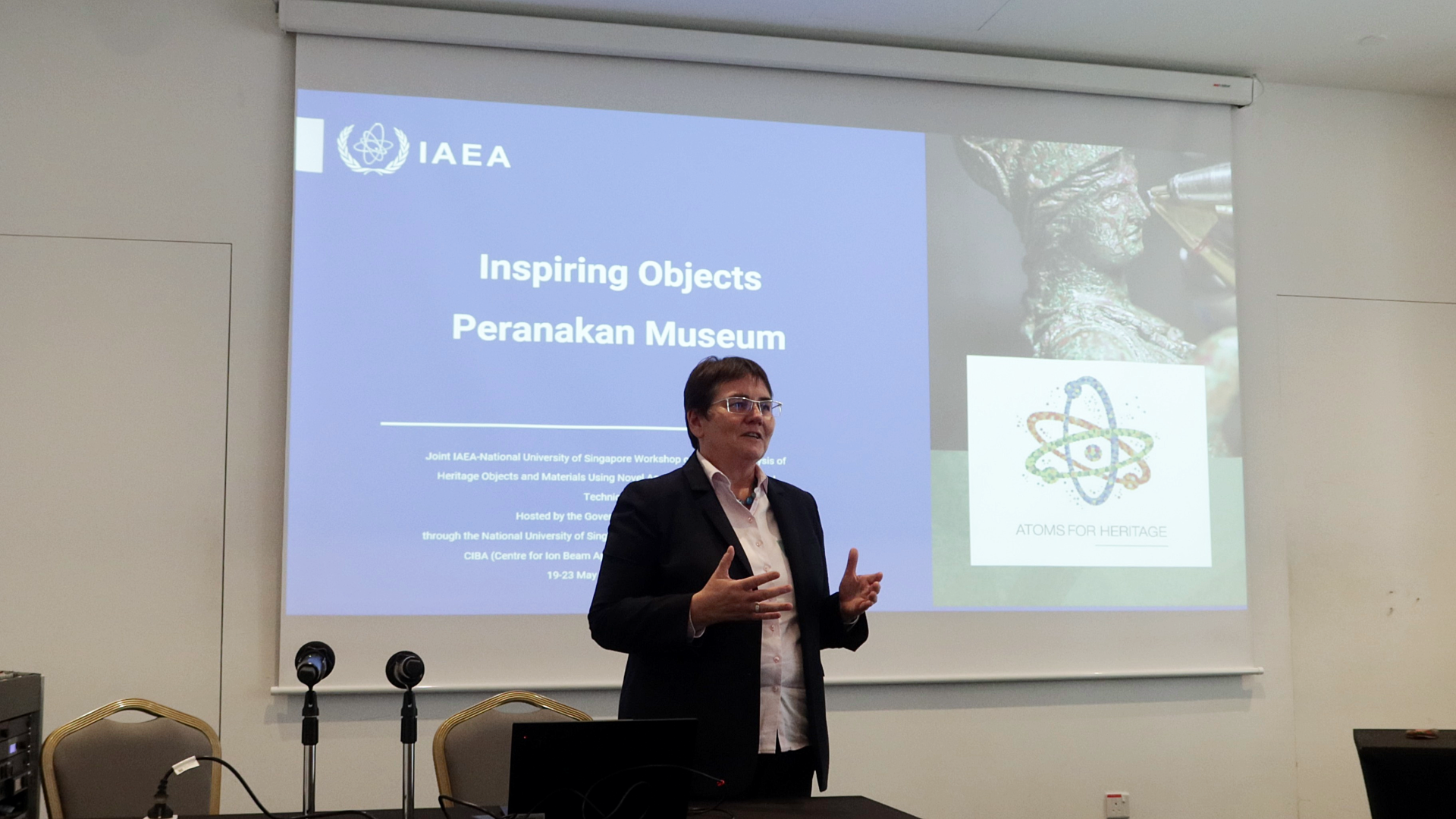
This question brought together scientists, conservators, curators, and archaeologists from around the world to the “Inspiring Objects” session co-organised by the International Atomic Energy Agency (IAEA) and the Singapore Synchrotron Light Source (SSLS) at NUS. Held at the Peranakan Museum on 20 May 2025, the session showcased how advanced analytical techniques – mostly powered by particle accelerators – are changing the way we understand and preserve art, history, and heritage.
The “Inspiring Objects” session is part of a five-day workshop, jointly organised by IAEA and NUS, to provide a comprehensive overview of the latest experimental advancements and methodologies to optimise best practices in accelerator-based heritage science.
“We are here to show how our colleagues in nuclear science can contribute to the preservation of cultural and natural heritage. Today, we are not diving into scientific complexity—but instead offering a glimpse of how these technologies can help us understand the past and connect with it in new ways,” said Dr Aliz Simon, a nuclear physicist at the IAEA Division of Physical and Chemical Sciences.
Using advanced scientific techniques to preserve cultural treasures
Accelerator technology utilises electromagnetic fields to propel charged particles such as electrons or protons to high speeds and energies which can give analytical information on objects at extreme sensitivity. This advanced technology can be used to analyse layers behind an object’s surface at the nanometre level without cutting or destroying the object. Harnessing accelerator techniques pushes the boundaries of analysing aspects of artefact properties such as pigments, art techniques and materials that are invisible to the naked eye.
At the “Inspiring Objects” session, scientists from 13 countries presented case studies, each demonstrating how accelerator-based and other advanced analytical methods can uncover the fine details of how artefacts were made and the process of degradation to better guide conservation and preservation strategies.
Presenting her study on a Portrait of Tan Beng Wan (1851-1891), Dr Agnieszka Banas, Principal Research Fellow from NUS SSLS, explained how the use of optical-photothermal infrared (O-PTIR) spectroscopy, a recently developed technique that measures infrared absorption with high spatial resolution and sensitivity, offers a promising alternative for the analysis of heritage samples. Using O-PTIR, she uncovered the chemical changes behind the whitish haze seen on the bottom left side of the painting that was subtly altering the painting’s appearance with fine layers and tiny particles of degradation products that older techniques could not detect. This included a thin layer of gordaite measuring less than 2 micrometres, and crystalline zinc soaps, providing essential data that conservators can act on.
“With novel technology, we’re able to zoom in like never before—to see the exact compounds causing deterioration. That means we can give conservators the precise information they need to act. This work isn’t just about solving puzzles. We’re doing it for future generations,” said Dr Agnieszka.
Unpacking the details of another uniquely Singaporean artefact, a piece of Peranakan beadwork, was Dr Krzysztof Banas, Principal Research Fellow from NUS SSLS. Using synchrotron-based micro-X-ray Fluorescence Microscopy (microXFM), the researchers traced how the colourful glass beads of the piece deteriorated over time.
“We found that the fading colours in these beads are caused by the leaching of potassium ions, which alters the internal structure of the glass. That discovery isn’t just scientifically interesting—it gives conservators a roadmap for how to protect these objects by controlling temperature and humidity,” said Dr Krzysztof.

45,000 years of stories – told through science
Among the presentations at the “Inspiring Objects” session were studies that span centuries, continents, and cultures, all brought together with a common goal of preserving key components of cultural heritage.
The oldest artefact presented at the session was the largest rock art region in Indonesia found in the Maros-Pangkep Karst area in South Sulawesi. This area is home to more than 400 rock art cave sites with distinctive images including hand stencil art, with squatting figures dating as far back as 45,000 years ago, making it a significant archaeological site. Using a combination of advanced analytical methods, the researchers from Indonesia found that the pigment weathering of these rock art images is due to the formation of whewellite, a mineral which is associated with microbial activity, on the pigment surface.
Drawing focus onto the musical arts, researchers from Italy uncovered the acoustic secrets of the 17th–Century Guarneri cello which belonged to Andrea Guarneri (1623-1698), the founder of a family of luthiers from Cremona, a city in Italy. Using synchrotron radiation (SR) phase-contrast microtomography, an imaging technique that uses X-rays to visualise the internal structure of materials, the researchers revealed the secret recipe behind the coating of the cello that could be responsible for the quality of these instruments.
Researchers from China also demonstrated how understanding the past can pave the way for future innovations. Using ptychographic X-ray computed tomography (PtyCT) combined with X-ray fluorescence computed tomography (XRF-CT), a method for 3D-imaging and elemental mapping at high resolution, the researchers found that the glaze on a Song Dynasty (960-1279 CE) ceramic from Jianyang kilns in the Fujian province, contains the crystals of a rare form of iron oxide. This form of iron oxide remains challenging to synthesise with modern techniques. However, studying these crystals could provide insight to its unique patterns, guiding modern synthesis for applications in Materials Science.
Science for the humanities
The session provided an eye-opening, cross-disciplinary journey through time and space, united by a single idea: that every object has a story, and sometimes the story can be retold with new facts and perspectives through the lens of science.
