


Advancing solutions to reduce marine plastic pollution through science and partnership
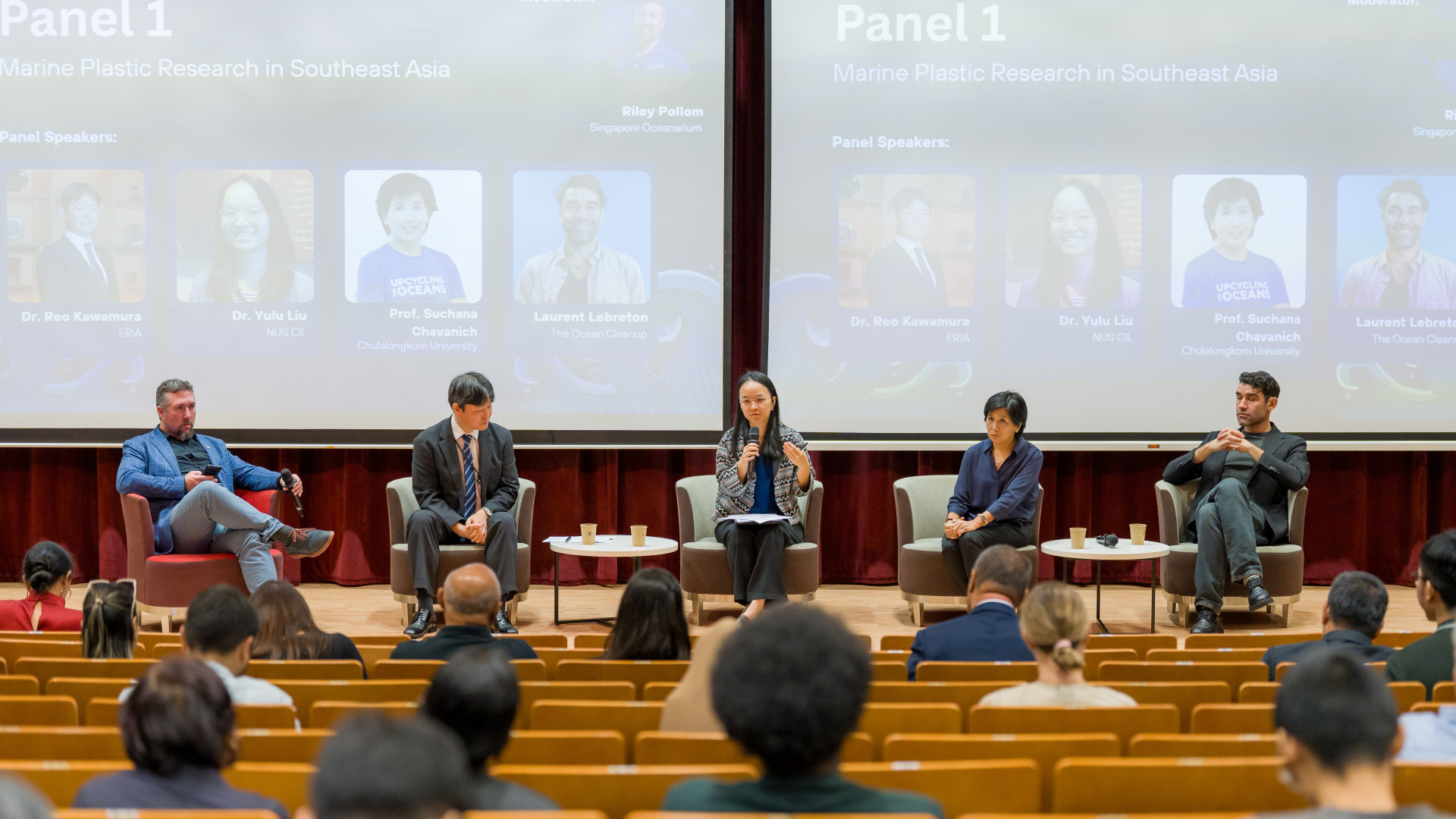
The NUS Tropical Marine Science Institute (TMSI) recently co-hosted a regional forum in Singapore focused on strengthening collaboration to reduce marine plastic pollution in Southeast Asia, a transboundary challenge affecting coastlines across the region.
Held at NUS University Town from 31 January to 1 February, the forum titled “Towards Healthy Oceans” organised with international non-profit The Ocean Cleanup, brought together researchers, policymakers, investors, philanthropies and private sector partners to examine how science-based solutions, implementation partnerships, and blue finance can be aligned to reduce plastic leakage from rivers into the ocean.
The discussions took place against growing evidence that marine plastic pollution is largely transboundary in nature. This is particularly relevant for Singapore, where a study by the National Environment Agency published in 2025 has shown that most plastic found on recreational beaches originates offshore, underscoring the need for coordinated, science-based regional responses.
“Marine plastics have been a persistent environmental concern for oceans in Singapore and around the world. Marine pollution is also a transboundary issue as the prevailing winds and currents can move litter across regional water bodies. To address marine plastic pollution effectively, our responses must therefore be supported by robust science-based approaches to guide actions and solutions that protect our local resources and shared oceans,” said Dr Neo Mei Lin, Senior Research Fellow at NUS TMSI.
Coordinated efforts needed to tackle ocean plastic pollution
The forum was structured around three core themes: science and technical solutions, partnerships and implementation, and finance and investment. Discussions included how advances in data, modelling and AI-enabled monitoring can help identify priority river catchments, guide river interception efforts, and support impact at scale.
The programme also aligned with The Ocean Cleanup’s 30 Cities Programme, which focuses on intercepting plastic in rivers before it reaches the ocean using data-driven systems. Southeast Asia was highlighted as a priority region, given that many of the world’s most polluting rivers are located within shared river basins that send plastics across national borders.
The first day focused on science and partnership development, covering marine plastic research, monitoring technologies, and remediation approaches. Speaking at the opening of the forum, Associate Professor Peter Todd, Director of NUS TMSI, highlighted regional marine plastic trends and the importance of coordinated scientific efforts. A keynote lecture on AI-enabled plastic monitoring was delivered by Dr Laurent Lebreton, Director of Research at The Ocean Cleanup.
NUS researchers contributed across multiple sessions. Dr Liu Yulu from the NUS Centre for International Law discussed governance and research gaps in Southeast Asia’s marine plastic landscape. “As the region lacks a centralised repository for marine plastic research, we worked with regional scientists to build a peer-reviewed database of more than 700 publications. The inventory shows that pollution monitoring is the dominant research focus and brings non-English studies into the science-based policy process to help governments prioritise their actions.”
Associate Professor Raymond Ong from the Department of Civil and Environmental Engineering (CEE) in the College of Design and Engineering at NUS shared perspectives on engineering innovations for plastic interception. Professor Karina Gin, also from NUS CEE, co-led a showcase on coastal and riverine pollution modelling and monitoring networks, supported by Dr Ashwini Suresh Kumar from TMSI.
The second day shifted attention upstream, exploring how cities, communities and policy design can reduce plastic leakage at source. Dr Neo from NUS TMSI moderated a panel session exploring the perspectives on community engagement and education approaches with local and regional representatives.
Sessions on finance examined how blue finance, philanthropic capital, and blended finance structures can support scalable ocean interventions, and how closer collaboration between science, implementation and finance communities can accelerate future pilots and partnerships across Southeast Asia.
“Plastic pollution does not respect borders because it travels with seas and crosses jurisdictions… progress at scale only happens when science, policy, business and communities move forward together. Singapore, with its strengths in science, policy, and finance, is well placed to bring together the partners and capital needed to address a transboundary problem through transboundary collaboration,” said Mr Boyan Slat, Founder and CEO of The Ocean Cleanup.
By convening regional stakeholders across disciplines, the forum aimed to strengthen collaboration pathways and support the development of practical, science-led solutions to marine plastic pollution at scale across Southeast Asia.
