


Creative works at NUS College's Impact Festival 2025 highlight service learning and community impact
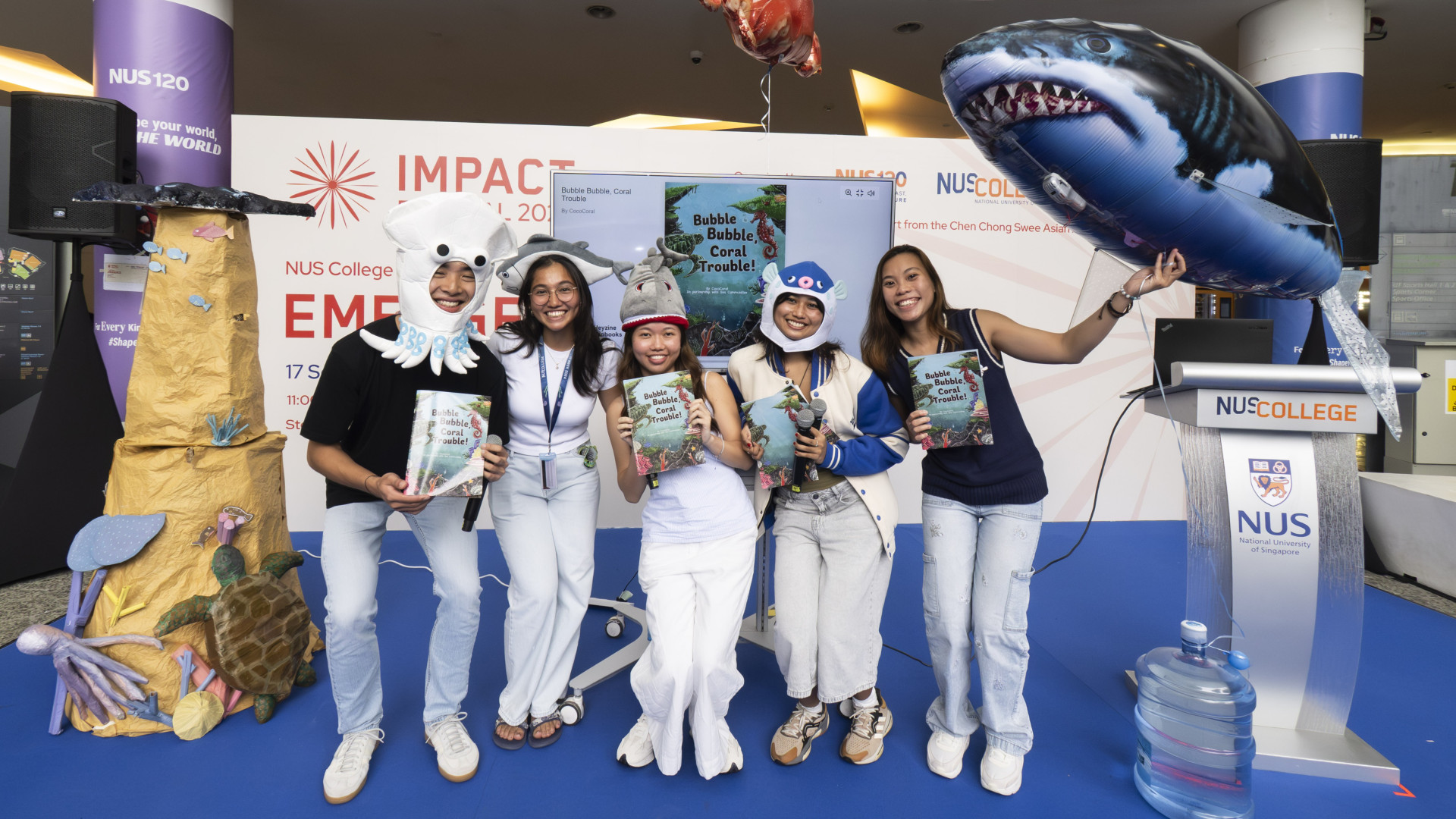
Two years of grappling with real-world problems to learn through service and community engagement culminated in a vibrant showcase of creativity at the inaugural Impact Festival on 17 September 2025, where the first cohort of NUS College (NUSC) students told the stories of their Impact Experience (IEx) projects through documentaries, books, games, performances and more.
Under the compulsory two-year programme, NUSC students form interdisciplinary teams and immerse themselves in communities in Singapore and Southeast Asia to understand the challenges they face, which span social, environmental, economic and cultural issues. Their goal is to devise solutions in partnership with the target communities to effect lasting social change.
Along the way, they gain a deeper understanding of the challenges in creating community impact, and a key IEx requirement to produce a creative work based on their experiences encourages them to find innovative ways of expressing their findings and reflections. More than 30 of these works were showcased at the Impact Festival under the theme “Emergence”.
In his opening speech at the festival, Professor Simon Chesterman, Dean of NUSC, described emergence as “the moment when diverse perspectives and deep engagement with the world give rise to something new,” such as the values of responsibility and empathy that have been fostered in the students through their IEx journeys.
“We chose the theme Emergence because it reflects both their growth and the new possibilities that arise when diverse people come together to tackle complex problems,” said Prof Chesterman. “What emerges is not just solutions to today's challenges, but a new generation of leaders who are imaginative, responsible and deeply connected to the region we call home.”
During the festival, NUS News caught up with four IEx groups about the projects and learning experiences that inspired their creative works. (More information about the creative works is available in the photo captions, which can be viewed by clicking on the photos to expand them.)
Home reDevelopment Box
Project Homecoming partnered with non-governmental organisation (NGO) New Hope Community Services to work on initiatives that would help former rough sleepers to settle into homes and reintegrate into society. One of the NGO’s projects was a new app that would reduce administrative strain on social workers by teaching clients useful skills like digital literacy and interview skills, with the students creating videos on conflict management that were then hosted on the app.
In the course of their work, they befriended a group of residents who were moving from transition shelters to rental flats under HDB’s Joint Singles Scheme (Operator Run), leaving behind the shelter community and struggling to find belonging in their rental flat environment. The students organised activities to bring the residents together, such as walking tours around their neighbourhood, mooncake and terrarium-making workshops, and a potluck that helped to forge community bonds over food and friendly conversation.
The varied circumstances that could lead to a person becoming a rough sleeper and the challenges of transitioning out of a rough sleeping situation, along with the unexpectedly rich inner lives of the individuals in these circumstances, shifted the students’ perspectives on homelessness and rough sleepers. Said Hirwan Shah, a Year 4 History major: “Getting to know more about their stories before and their aspirations afterwards built up a more complete character of each person that changed my idea of what a rough sleeper is. They’re just as normal as you and I, and there was nothing special that caused them to be in that current state.”
They told some of these stories through the Home reDevelopment Box, a model of a four-storey Housing Development Board (HDB) block that depicts the stages of the homelessness journey and what home means to different people. It invites audiences to consider the circumstances and emotions that rough sleepers experience and think about what home means to them.
Alongside Elephants
Alongside Elephants is one of several IEx groups in the first cohort of NUSC students that worked closely with the Karen village of Huay Pakkoot, Thailand, where elephants are as much a part of the community as people are. Their goal was to improve understanding and awareness about the different types of elephant care, as well as the economic, cultural and social constraints that make certain practices necessary.
They spoke to carers, veterinarians and owners of elephant camps and took away new perspectives on how elephants are viewed and treated in Thailand. For example, the use of a chain to tether an elephant to a tree when its carer has to leave it alone may seem cruel at first glance, but a long chain is a practical compromise that gives the elephant some freedom while ensuring the safety of nearby villagers, as it prevents the elephant from wandering into farmland or homes.
“One camp business owner told us that if he could free all the elephants in Thailand and put them in the forest, he would. But the reality is that there’s not enough forest space in Thailand now to free all the elephants without them getting injured or getting into human-elephant conflict,” said Ryan Lim, a final-year student majoring in Southeast Asian Studies. Currently, allowing elephants to roam 24/7 in the limited forest area would require twice as much manpower to supervise them, which would be financially challenging, he added.
He shared: “The main thing they wanted to tell us was not to stigmatise or villainise one form of care over another, but to really look at the context.”
The students compiled their in-depth interviews, photos and videos into a 144-page book in English and a companion website with more content, such as interview excerpts in the original Thai and the villagers’ local language, endeavouring to tell the community’s stories as accurately and accessibly as possible. In addition, they produced a 10-minute documentary on a day in the life of an elephant carer in Huay Pakkoot. The group is now exploring avenues to print and sell the books in Thailand so that the Thai people will benefit directly from their work.
Voideckies
Like a blank piece of paper, an empty void deck represents potential and an opportunity to create something special. When the Voideckies team set out to turn a void deck in Bukit Purmei into a community space for their IEx project, they initially hoped to transform it physically through a redesign and new furniture. But they quickly learnt the strict and specific rules governing space in Singapore, which made their plans impractical.
Undeterred, they pivoted into finding other ways to nurture community and landed on the idea of biweekly game nights that would appeal to both the elderly and children. While the concept was simple, the consistent schedule and accessible nature of the games they chose, like bingo and snakes and ladders, kept residents engaged and coming back to interact together over games every other week.
The students hope their project can be a case study or framework for others looking to build community in simple ways. Said Vera Lui, a Year 4 Chemistry major: “Most of the events in HDB void decks are centred around festivals like Chinese New Year and Hari Raya, rather than regular events that people of all ages would want to take part in. This could be a prototype for more regular community activities.”
The lessons they learnt about rules for void deck use, such as restrictions on noisy sports, were translated into a board game where players take on the roles of residents in an HDB block who have different interests and desires that sometimes conflict. As players work towards getting their desired furniture – ranging from a mahjong table to swing sets, mama shops and television sets – they must compromise to create a void deck that meets as many needs as possible.
3D Virtual World of the Kampungs
In Kampung Air, a village in the town of Semporna in Malaysia’s Sabah state, trash generated by villagers and tourists that accumulated both on land and in the surrounding waters was a persistent problem. Team 5W1M (SWIM) worked with the village residents and community partner Borneo Komrad to create a net barrier from local materials to prevent trash from drifting in with the tides. This helped to reduce the volume of waste within the village so garbage collection firm Amwil could work on cleaning up the area, and paved the way to addressing the long-term health and environmental issues resulting from poor waste management.
Through the process of designing, implementing and refining the solution, the students learnt about gaining trust and communicating effectively to create impact with a community. Elren Chae, a final-year Biomedical Engineering major, noted that while Zoom meetings with Borneo Komrad were useful for some discussions, they could only make real progress on the design during their field trips, when the whole team was together in person. “Dealing with situations like this is part of what’s unique about IEx, and I hope that our learnings with Borneo Komrad will help future IEx groups to build on our relationships with the community,” said Elren.
For their creative work, they used Minecraft, a popular sandbox game, to create a virtual simulation of the village. Players can explore the village without visiting it physically, experiment with the net barrier to see its impact and interact with other players or non-playable characters based on the villagers. The virtual twin of the village serves several purposes besides educating viewers about the net barrier project and waste management. For instance, as many of the villagers are stateless and cannot travel, the Minecraft village provides them with an avenue to tell their story and share their experience with people overseas. Another consideration was that the village has been slated for eviction, and the Minecraft platform helps to preserve the residents’ memories of the space.
The team intends to hand the Minecraft project over to Borneo Komrad, who may use it to recreate local areas of interest to attract tourists to visit in person or build prototypes before investing in new community projects.
