


NUS scientists join global effort to unearth dark matter and exotic particles
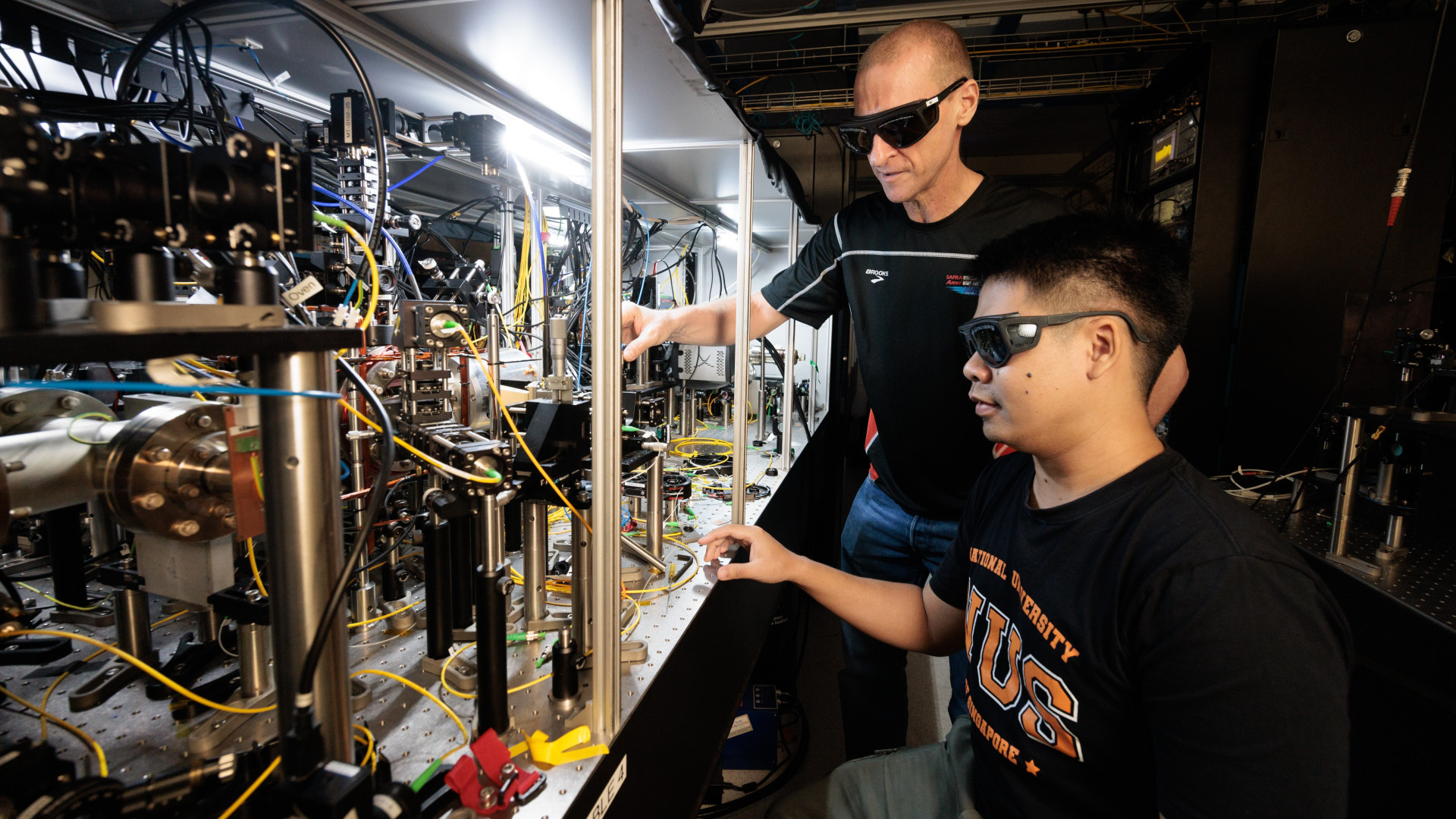
Scientists from the National University of Singapore (NUS) are poised to make significant contributions to global efforts aimed at uncovering dark matter and discovering exotic astrophysical particles, with the potential to transform our understanding of the universe and redefine fundamental principles of physics. They are part of the Singapore team joining the Global Network of Optical Magnetometers to search for Exotic physics (GNOME), an international scientific collaboration pushing the boundaries of physics to explore dark matter and other exotic astrophysical particles.
Dark matter refers to a new type of fundamental particle or particles that interact with ordinary matter through gravity. Such particles are undetectable through conventional methods, making it exceptionally challenging to observe directly. However, the presence of dark matter can be inferred through gravitational effects on visible matter.
GNOME’s network of 15 stations located in some of the most prestigious research institutions around the world collect magnetic field signals from quantum sensors across these stations. By analysing the collective data of the GNOME network, scientists hope to uncover the presence of dark matter.
The Singapore GNOME unites the strengths of the National University of Singapore (NUS), Centre for Quantum Technologies (CQT), Agency for Science Technology and Research (A*STAR), and Nanyang Technological University (NTU). It leverages world-class atomic clocks from NUS, which are managed by Associate Professor Murray Barrett and his team at CQT, as well as advanced quantum magnetometers from A*STAR, cutting-edge atomic gravimeters from NTU, and enhanced cloud computing and machine learning functions from Amazon Web Services (AWS) Singapore.
Assoc Prof Barrett, who is from NUS Department of Physics and CQT, said, “The unprecedented precision of optical clocks opens new scientific opportunities such as the search for new physics or possible dark matter models. My team’s lutetium clock project has established this capability in Singapore, and I am delighted for the opportunity to contribute to GNOME.”
As a member of GNOME, Singapore expands the network’s geographic coverage with its equatorial location, improving the accuracy of global data collection and analysis. Singapore’s inclusion in this prestigious network will foster knowledge exchange, driving innovations and generating economic impact across different fields, including biomedical imaging, navigation systems, and environmental monitoring.
Read more here.
