


NUS study: Singapore is on track to meet its 2030 solar energy goals
By Dr Bellam Sreenivasulu
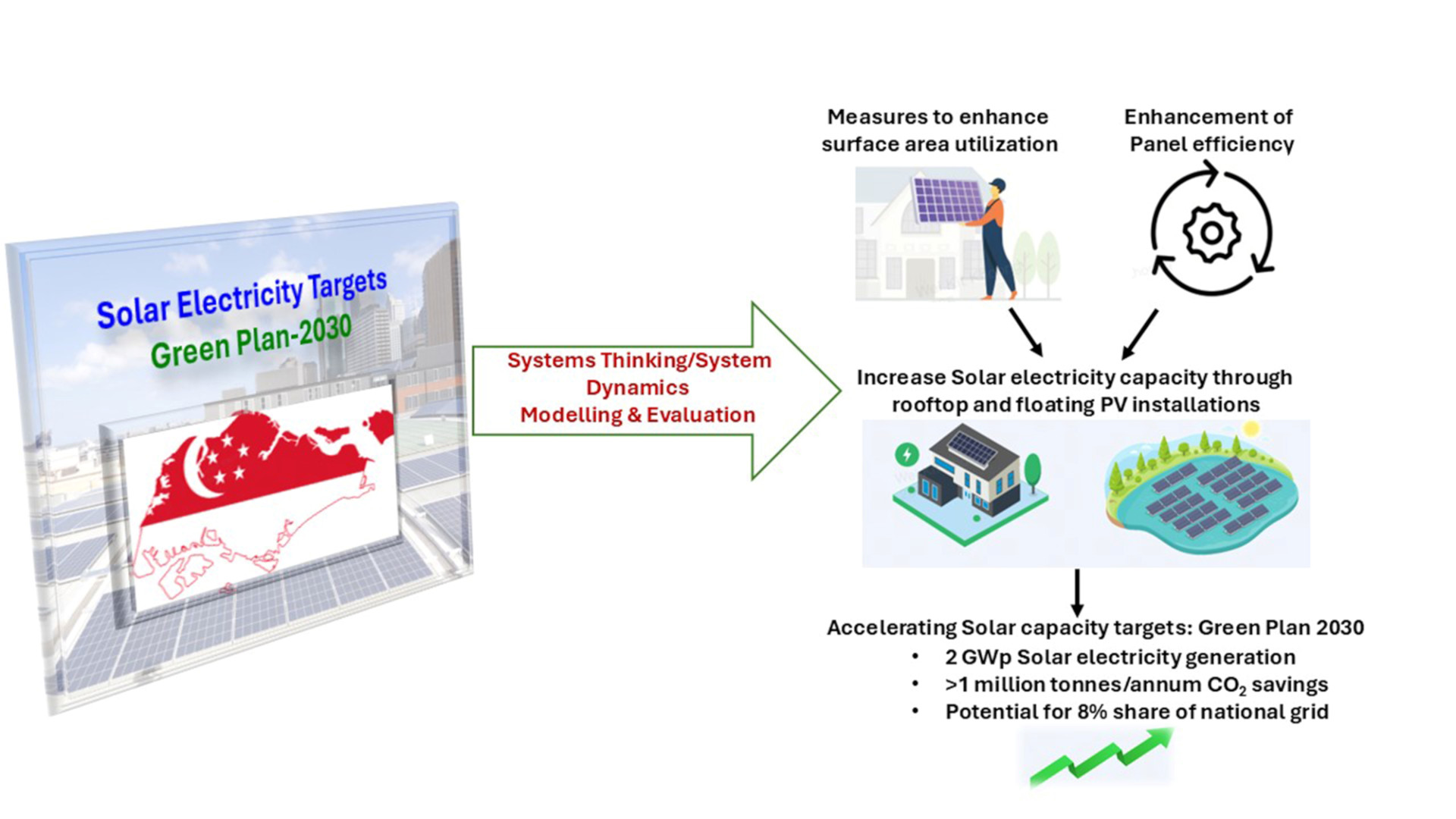
Currently, Singapore relies heavily on natural gas, which accounts for 95 per cent of its energy needs, highlighting the critical need for diversification into renewable sources. According to the Sustainable Energy Association of Singapore, solar energy has the potential to meet approximately 17 per cent of the nation’s electricity demand. Singapore’s Green Plan is ambitiously targeting a six-fold increase in its solar electricity capacity, aiming to achieve 2 Gigawatt-peak (GWp) of solar electricity by 2030, up from the current 300.3 Megawatt-peak (MWp) in its commitment to addressing climate change, and towards safeguarding the nation’s energy security.
This focus on solar energy is driven by key challenges that include limited land availability for ground-mounted solar photovoltaic (PV) panels and Singapore’s constraints on wind and nuclear energy options, making solar energy a pivotal component of its renewable energy strategy. The growth of solar PV installations in Singapore will be significant, with plans to reach a capacity of 6 GWp through the utilisation of rooftops and floating PV systems.
In our recent study, published in Applied Energy in August 2024, we employed systems thinking and system dynamics (ST&SD) modelling methodology to evaluate Singapore’s aspiring solar energy capacity targets, carbon emission savings, and the overall energy mix.
Understanding energy systems through a system dynamics approach
ST&SD is a methodology designed to understand the holistic behaviour of complex systems over time. It encompasses several key stages/processes: problem structuring, which involves identifying and framing the problem within the system’s context; causal loop modelling, which creates a qualitative model to show feedback loops and causal relationships; dynamic modelling, which develops stock and flow diagrams as quantitative models for formulation and simulation to generate system behaviour under various scenarios; scenario planning and modelling, which explores different future scenarios and their potential impacts; and implementation and organisational learning, which applies insights from modelling to real-world situations and fosters a culture of continuous learning and adaptation. This methodology is a powerful tool for tackling complex problems by providing a structured approach to understanding and influencing system behaviour over time.
Adopting this systems approach, we considered four main subsystems to include in the model for formulation and quantification, namely installation of PV panels, cost of solar electricity, carbon emission savings, and energy demand. The base model simulations focused on key variables affecting solar electricity capacity, including comparing peak solar capacity with the government’s expected peak capacity, the share of solar electricity in Singapore’s national grid, and net carbon emission savings. Policy simulations and evaluations were conducted by appending the base model with other policy scenarios, such as area and utilisation factors for PV installations, as well as subsidies and panel efficiency. Simulations were performed on these policies individually and in combination to provide a comprehensive analysis of their impacts.
Meeting our solar energy targets ahead of schedule
According to projections by the Solar Energy Research Institute of Singapore, the share of solar energy in the national grid is expected to be between 2 to 6 per cent in 2030 and 3.5 to 8 per cent in 2040, with carbon emission savings of 0.5 to 1.4 million tonnes per annum in 2030 and 0.8 to 2.1 million tonnes per annum in 2040. Our simulations and policy scenarios align with these projections, showing that the share of solar energy could reach 3.9 per cent in 2030 and 5.1 per cent in 2040, with annual net carbon emission savings of 1.1 million tonnes in 2030 and 2 million tonnes in 2040. These results indicate that Singapore is on track to meet its solar capacity target of 2 GWp by 2030, potentially even earlier by 2028.
Based on the results of our study, we recommend for Singapore to aim for an 8 percent share of total electricity generation by 2040 to effectively implement Green Plan policies such as enhanced land use efficiency, subsidies, and improved solar panel efficiency. Additionally, Singapore needs to explore additional alternative energy sources to meet its growing energy demand and net-zero targets while ensuring energy security.
The ST&SD methodology discussed here can complement existing initiatives and policies by various agencies, stakeholders and the government in planning long-term energy security solutions for a land-scarce country like Singapore. These efforts will be crucial for securing an environmentally friendly energy mix and deployment in Singapore’s context.
This study was developed as part of a semester-long undergraduate research project under the UTC2704 Projects in Systems course offered at Residential College 4. In this senior seminar, each student under supervision will apply ST&SD methodologies and skills to simulate and understand complex issues, including those related to energy systems, such as sustainable energy, renewable energy, and carbon emissions.
 About the author
Dr Bellam Sreenivasulu is a Senior Lecturer and Resident Fellow at Residential College 4. He teaches systems thinking and system dynamics courses and supervise students in relation to energy systems and related issues on sustainable energy production, energy supply and demand, energy security, and carbon emissions. Dr Bellam is passionate about designing and implementing effective, impactful, interdisciplinary, student‐centred pedagogy to enhance students' critical and systems thinking skills.
