


TS2 Demo Day 2025: Social impact start-ups tackle pressing challenges amidst Singapore’s evolving population
Traditional mental healthcare often relies on self-reported symptoms, which can be misleading or result in delayed treatment. But what if early signs of anxiety could be detected through your heartbeat, voice, or facial expressions, even before you are aware of your symptoms? Universal Health, a social impact start-up from Singapore, is the first in Asia to pioneer this approach. Its AI-powered platform identifies stress markers and predicts mental health risks, enabling proactive, preventive care.
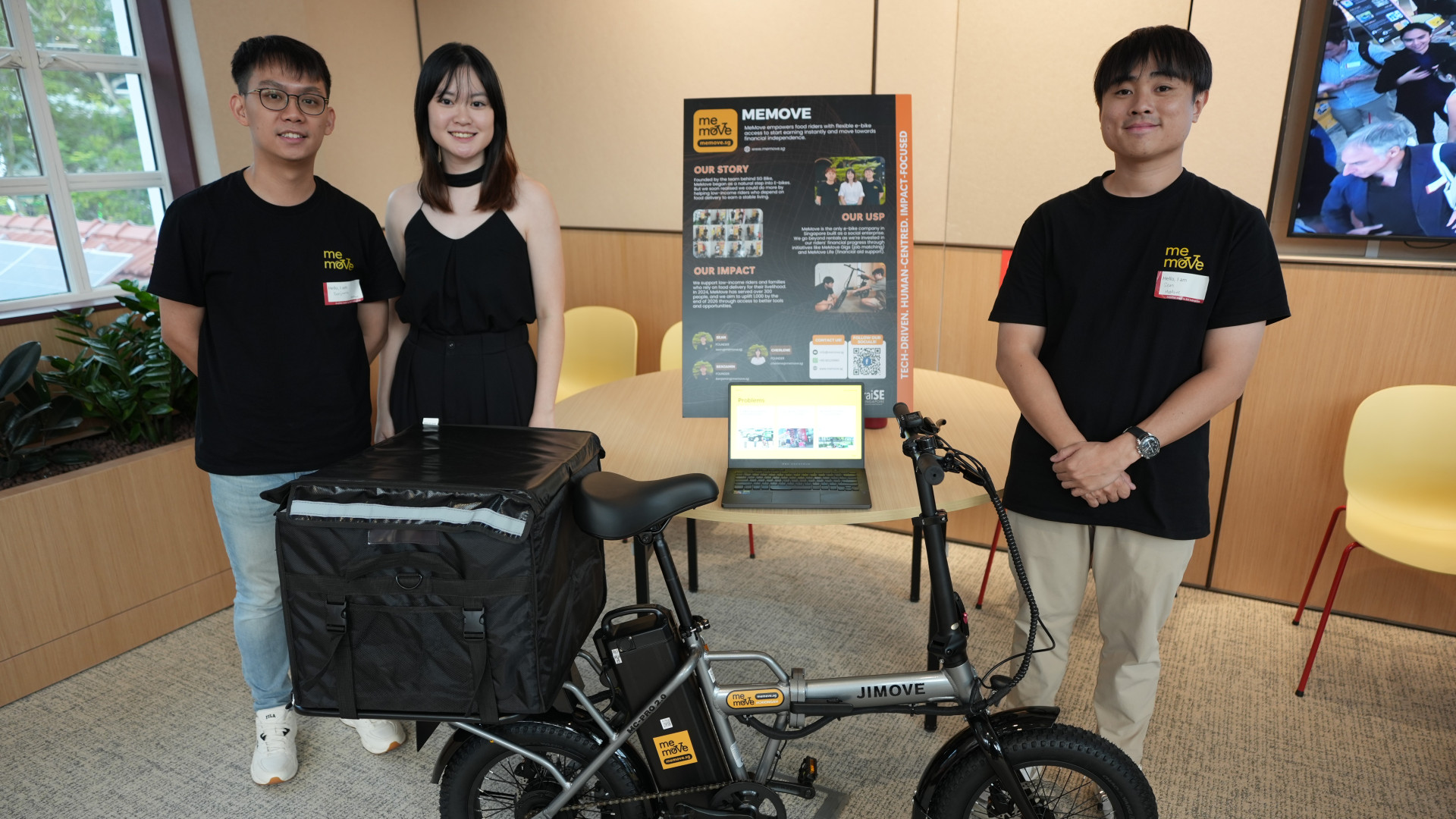
For gig economy workers, earning a stable income is just as challenging. Without the right tools, financing, or career support, many struggle to increase their earnings. MeMove aims to change that. Its mobility platform provides flexible e-bike financing and resources that empower food delivery riders to increase their income, unlock new opportunities, and move up the social and economic ladder.
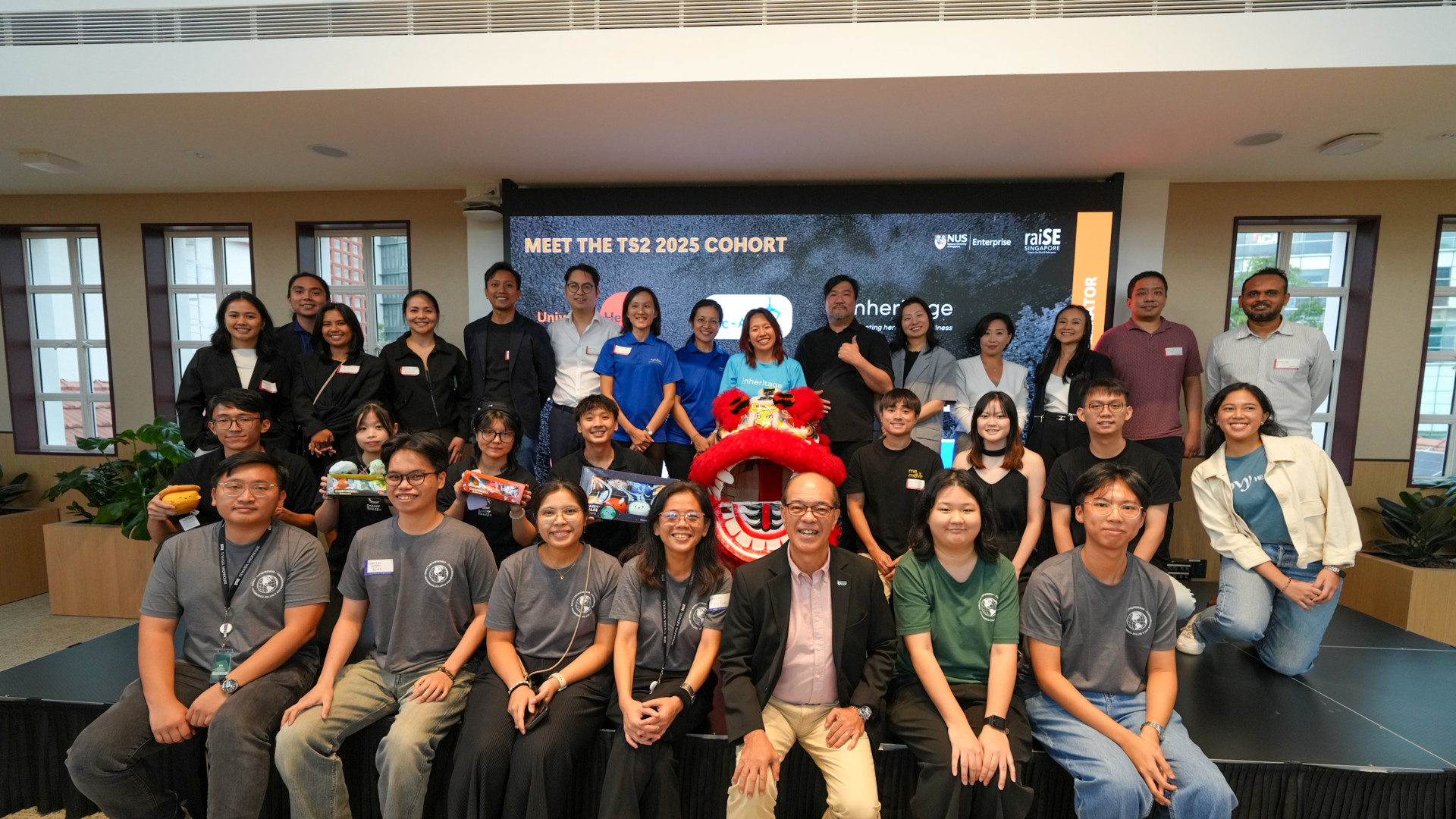
MeMove and Universal Health are two social enterprises that are part of the second cohort of the Technology for Sustainable Social Impact (TS2) Accelerator Programme, a collaborative initiative by NUS Enterprise and Singapore Centre for Social Enterprise (raiSE). Both start-ups showcased their latest tech-based innovations at the TS2 Demo Day on 25 November 2025 at the newly refreshed Temasek Shophouse, along with eight other promising social impact start-ups from Singapore, South Korea, Indonesia and the Philippines. Participating start-ups will receive a grant of up to S$100,000 from raiSE to support the development and scaling of their tech-enabled innovations.
With Singapore navigating demographic shifts and evolving social challenges, technology and social impact are essential partners. These start-ups prove that sustainable solutions can be both profitable and purposeful. With the right support through platforms such as the TS2 Accelerator Programme, today's innovations can become tomorrow's lifelines for communities in need.
In his welcome address at the TS2 Demo Day, Mr Brian Koh, Director (Field – Ecosystem) at NUS Enterprise, emphasised: “The double bottom line isn't built alone; it takes a village. We are calling on all who share this vision to work with us in creating start-ups that generate returns while impacting lives.” He highlighted the TS2 programme’s holistic support through mentorship, funding, and networks to help start-ups grow and scale their business.
The event was attended by over 150 attendees from the social services sector including industry partners, corporate representatives, invited guests and NUS alumni.
Turning technology into tangible impact
Launched in 2024, TS2 is a highly customised 10-week venture development programme for impact-driven technology start-ups addressing community needs across four themes: Health & Wellness, Education, Seniors, and Social Mobility. Founders gain access to mentors, investors and social impact professionals, as well as opportunities to explore overseas markets through NUS Enterprise’s BLOCK71, a global network of physical accelerators in 11 cities.
The tech-enabled innovations from the ten growth-stage, impact-driven tech start-ups in TS2 2025 are addressing diverse critical social needs in:
Health & Wellness: Eyeviser (Singapore), Ovy Health (Indonesia), Universal Health (Singapore)
Education: Assemblr (Indonesia), Pic-A-Talk (Philippines), Thinklery Group (Singapore)
Seniors: Inheritage (Singapore), RetireGenie (Singapore)
Social Mobility: KIMU STUDIO (South Korea), MeMove (Singapore)
An ecosystem that nurtures growth and success
The seven start-ups from the inaugural TS2 cohort in 2024 have shown how early support can drive meaningful progress. Beyond the programme, they continue to receive guidance from the BLOCK71 Social Impact Hub through additional workshops, mentoring, check-ins, and structured progress reporting. Many have expanded overseas, earned global recognition, and empowered hundreds of underserved individuals.
FingerDance (Singapore): Supported by SBS Transit and the Deaf Association, it launched the Sign Language Virtual Assistant (SiLViA) at Chinatown MRT Station (B2, Exit E) on the Northeast Line, making public transport more inclusive for the hard-of-hearing.
GoTechUp (Singapore): Running pilot programmes in STEM (science, technology, engineering, and mathematics) at four community centres, it reached 82 underserved students with limited access to quality learning opportunities, trained 17 volunteer educators and is on track to engage 340 students in Singapore. The team is currently working with a partner to develop localised content for pilot deployment in Indonesia.
MADCash (Malaysia): Supported women micro-entrepreneurs through partnerships with YWCA, Mendaki, and Majurity Trust in Singapore, and delivered micro-business programmes in Indonesia in collaboration with Bettr Academy.
Mr Alfie Othman, Chief Executive Officer, Singapore Centre for Social Enterprise (raiSE) puts it across simply, “Our focus at raiSE is to embed impact into business models from day one, building ventures that are not just commercially viable, but also create lasting social change. We understand that visionary founders are the catalyst for this dual mission. Through the TS2 accelerator programme, we are proud to actively support these leaders in developing and harnessing innovations to reach underserved communities more efficiently and effectively.”
By NUS Enterprise
