


NUS Law students shine as top mooters and arbitrators at home and abroad
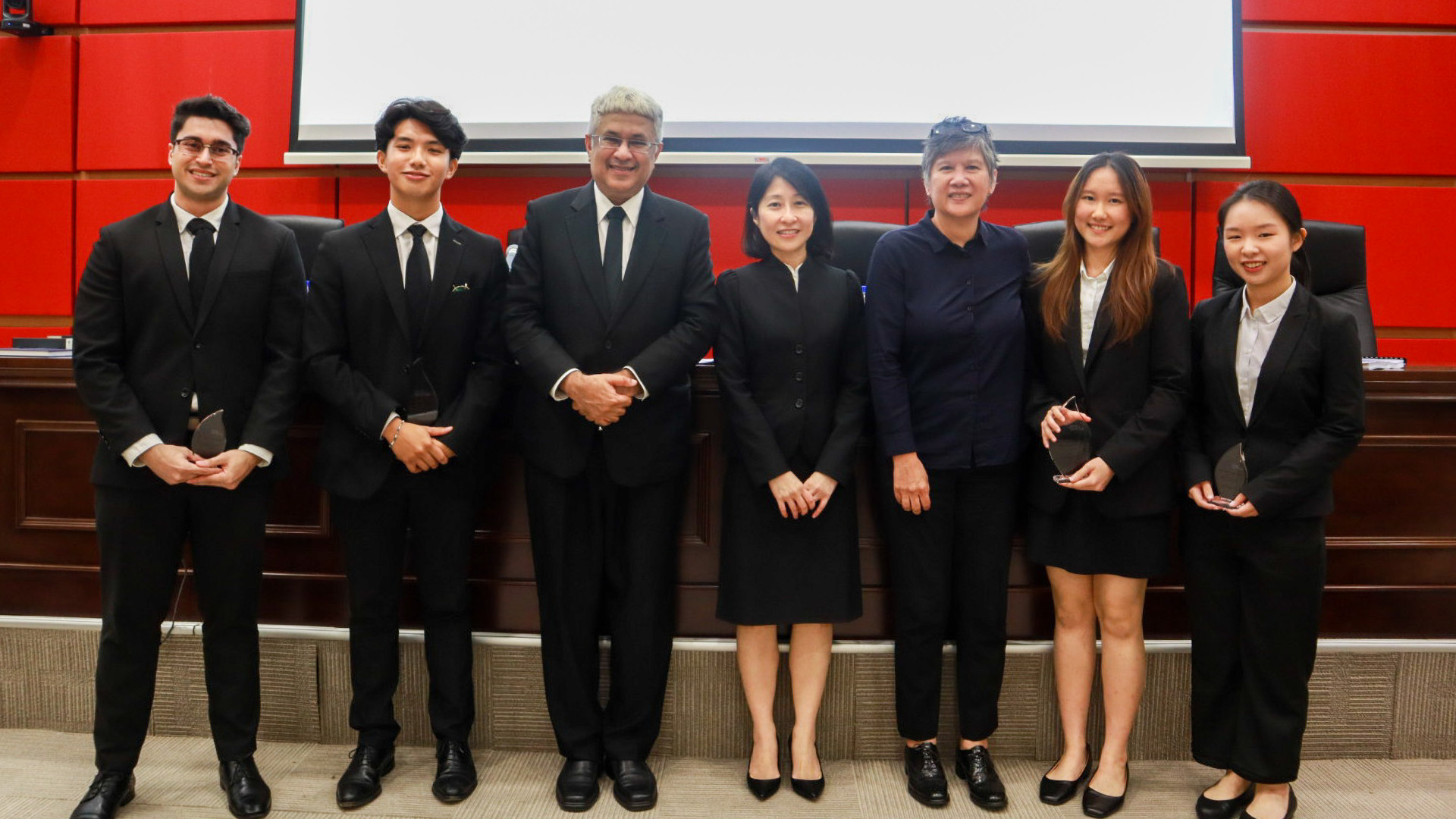
NUS Law students have done the Faculty proud with their excellent performances in two recent moot court competitions – one held in Singapore and the other in Paris, France.
Sweeping the top prizes at B.A. Mallal Moot 2024
It was a clean sweep for NUS Law undergraduates at the B.A. Mallal Moot 2024 held in October.
Jeremiah Tan and Tan Kai Han, who are both in their penultimate year in NUS Law, took home the first and second prizes respectively, while second-year undergraduates Shaun Wittberger and Nicole Won were jointly awarded the second runner-up position. The winners bagged $3,000, $1,500, and $500 (joint second runners-up) in prize money respectively.
Another team mate, Melvin Seto, a final-year Law student, earned the Best Memorial Prize and the accompanying $250 cash prize for the best written legal document to support his position in the case.
The B. A. Mallal Moot is one of Singapore’s oldest and most prestigious mooting competitions, co-organised by the NUS Law Mooting and Debating Club and leading Singaporean law firm Allen & Gledhill LLP. The competition attracts participants from all three law schools in the country annually.
This year, more than 100 law students battled it out over a series of four gruelling mooting rounds – the preliminaries, quarter-finals, semi-finals and the grand finals. With AI proliferating in many aspects of life, it was timely that the students debated the topic of tortious liability for injuries arising from statements made by an AI chatbot and even considered issues around criminal liability for alleged stock market manipulation by an AI chatbot.
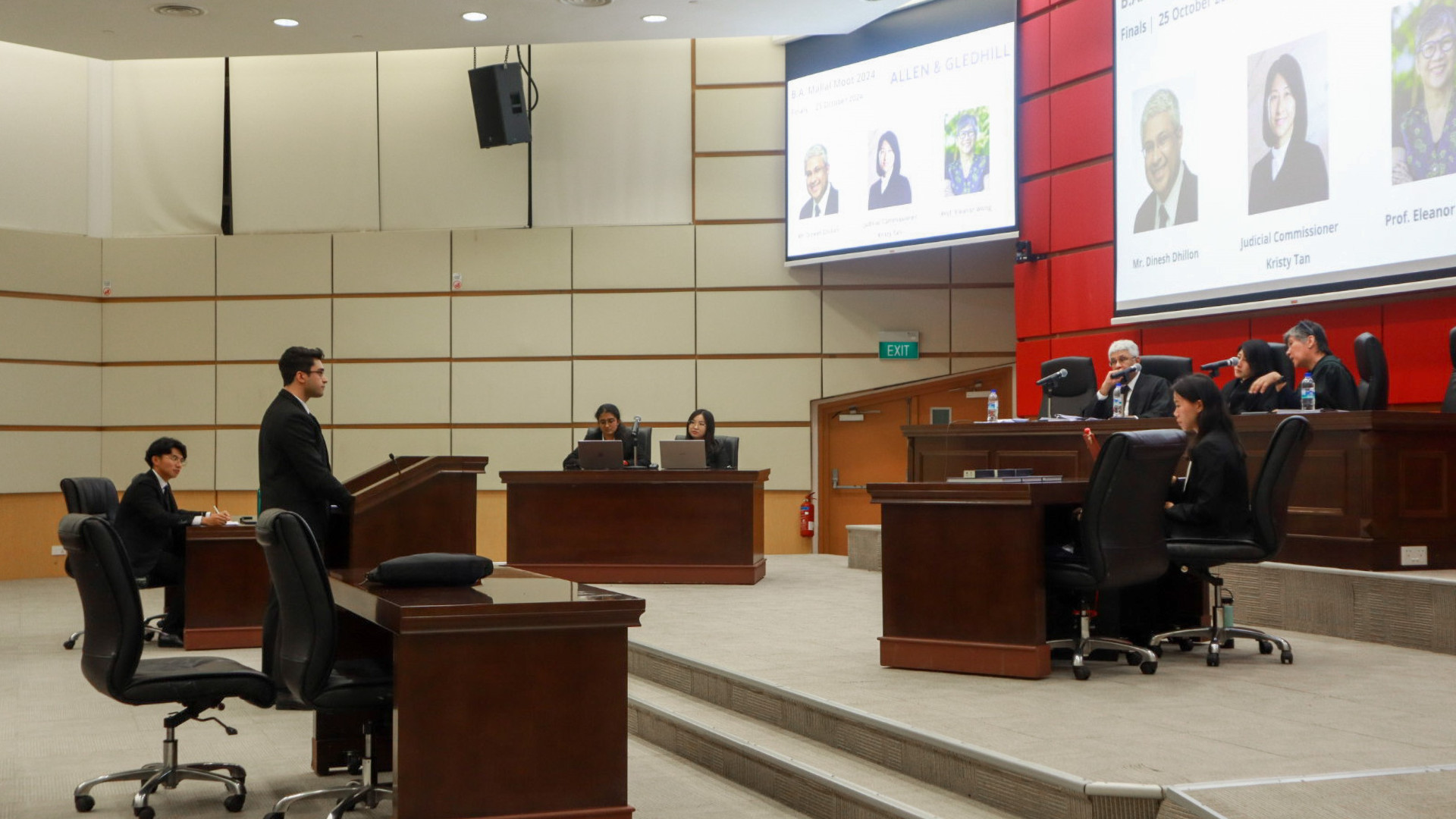
Jeremiah decided to participate in the competition given the intellectual rigour of this year’s moot problem despite having “a bit of an aversion to mooting” as he does not consider himself especially eloquent. His approach prioritised assisting the court in understanding his arguments rather than resisting their questions. A key takeaway was how mooting “is not about sounding the smartest or most polished, but about engaging the judges in a conversation.”
“I think sometimes our fears are an illusion. I hope my win encourages other students to try something that they've always been afraid of. Who knows, you might end up exceeding your own expectations!”
Kai Han shared how the moot problem for the preliminaries and quarter-finals was somewhat nostalgic as it involved elements of both contract and tort law, both of which were courses she took in her first year of study.
She added, “While my foundational knowledge in these areas of law helped me, the difficulties in applying existing law to a novel hypothetical situation involving artificial intelligence made me deeply aware of how law is a living, breathing thing, and how our generation of lawyers will have to grapple with the impacts of unprecedented technological advancements on our current law.”
One of the judges for the moot, Mr Dinesh Dhillon, Partner and Co-Head of International Arbitration Practice at Allen & Gledhill LLP, was pleased with the high standards of the competition, noting that all the finalists did exceedingly well.
Sharing some tips on mooting, he said, “An important point to bear in mind is that oral advocacy is not debating, and eloquence that may win the popular vote is not determinative of what wins over a Judge. Legal advocacy is primarily about evidence and the law. Hence, applying the relevant facts with reference to the relevant statutory and case law is essential.”
Honing cross-examination skills in the prestigious Cross Examination Moot 2024
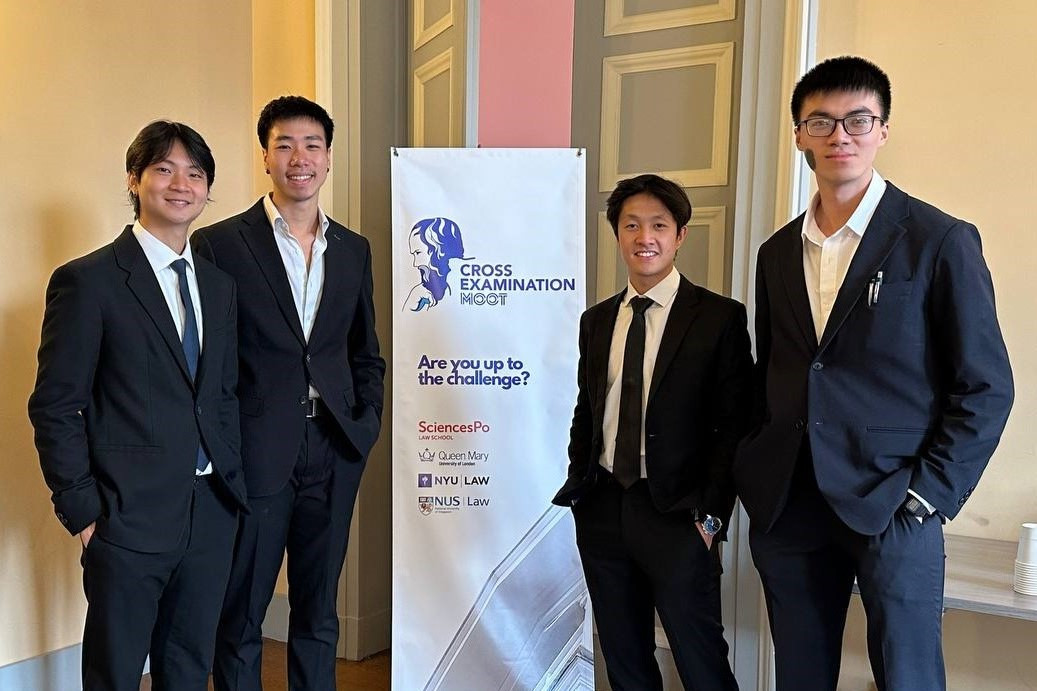
Over in France, another team of students from NUS Law emerged the first runner-up among 15 teams at the prestigious Cross Examination Moot 2024 in November. Organised by Sciences Po Law School this year, the event is the world’s only arbitration competition that focuses on cross-examination techniques where participants argue a case by examining and cross-examining witnesses in a mock-trial scenario.
Over a week, the team comprising fourth-year student Tan Yan Ren, third-year student Ronn Chiew, and second-year students Joshua Lim and Nathaniel Yeo, competed in four general rounds cross-examining fact witnesses, followed by two rounds cross-examining real quantum expert witnesses from economic consulting firm Compass Lexicon. In the grand finals on 20 November 2024, the finalists engaged in a commercial dispute arising from an alleged theft and development of confidential AI healthcare technology.
On top of the team win, Yan Ren was awarded the Best Cross Examiner Award for Quantum, for his cross-examination of quantum expert witnesses. The experience was a memorable one, he said: “As students, it was a rare opportunity to test our cross-examination skills on real expert witnesses, as well as to deviate from the usual legal arguments to talk about damages.”
The competition exposed participants to a diverse pool of arbitrators, who had slightly different expectations of what constitutes good cross-examination, depending on their legal backgrounds. Nathaniel observed that some of the cross-examination techniques and strategies commonly used in Singapore and common law jurisdictions were not well received by arbitrators who had different legal backgrounds. As a result, the students had to adapt their approach based on the arbitrators judging each round.
They drew on lessons from NUS courses on comparative law, which provided them with an understanding of differing legal cultures, and trial advocacy. The latter is taught by Mr Joel Quek, a commercial litigator from WongPartnership LLP who also coached the team. In addition, the team researched on the arbitrators beforehand, paid close attention to the arbitrators’ reactions to their cross-examination, listened to their feedback, and learnt by observing other teams’ performances.
"Participating in the cross-examination moot court competition provided us invaluable insights into the practical workings of international arbitration, particularly outside Singapore. It was an eye-opening experience to observe and adapt to diverse oratorical and mooting styles, while also learning about different advocacy cultures and approaches across jurisdictions,” the team reflected.
