NUS launches S$50M National Centre for Engineering Biology to accelerate AI-guided sustainable biomanufacturing
The Centre brings together AI, automation, shared data platforms and pilot-scale bioprocessing to advance predictive biological design for manufacturing specialty chemicals.
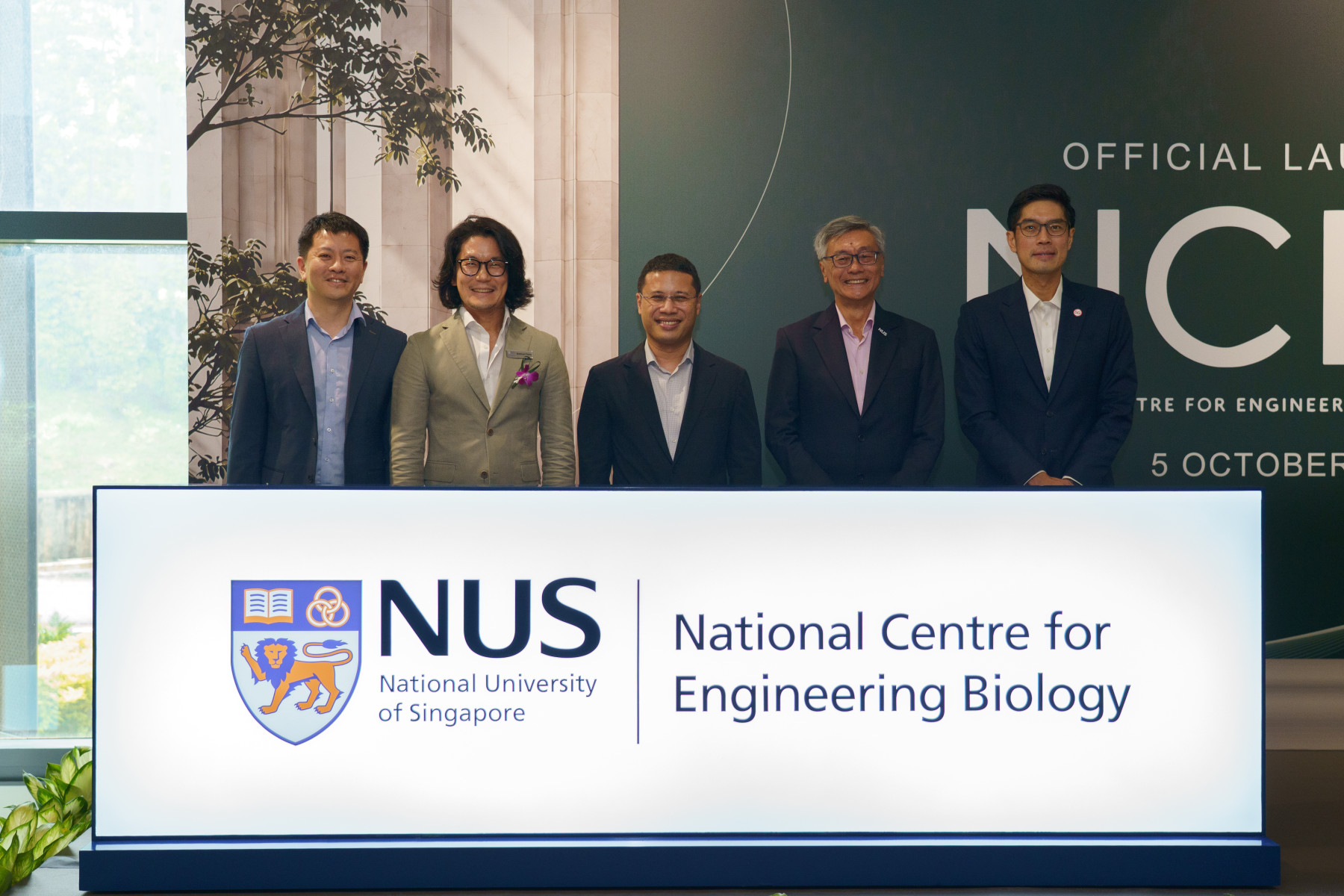
The National Centre for Engineering Biology (NCEB), hosted at NUS, was officially launched today together with its new research facility. Mr Desmond Lee, Minister for Education and Minister-in-Charge of Social Services Integration, graced the occasion as Guest of Honour. The national-level centre will build foundational knowledge and technologies in engineering biology for the sustainable biomanufacturing of specialty chemicals, an important class of high-value products and materials.
Established in partnership with Nanyang Technological University, Singapore Institute of Technology, Temasek Polytechnic, Nanyang Polytechnic, and the Agency for Science, Technology and Research, NCEB enables new research discoveries, drives technological advancement and develops the talent needed to design and engineer living systems predictively. This whole-of-nation platform strongly positions Singapore in the field internationally. Supported by the National Research Foundation (NRF) under the Research, Innovation and Enterprise 2025 (RIE2025) plan, the Centre was established through the NRF Mid-sized Grant of close to S$50 million awarded over seven years from 2023.
“NCEB builds on engineering biology capabilities developed over more than a decade, anchored by initiatives such as the NUS Synthetic Biology for Clinical and Technological Innovation (SynCTI) and the Singapore Consortium for Synthetic Biology (SINERGY), and reinforced by strong industry partnerships and interdisciplinary expertise across science, engineering, medicine and computing,” said Professor Matthew Chang, who leads NCEB as Executive Director. He is also the Director of NUS SynCTI and SINERGY, and holds an appointment in the Department of Biochemistry at the NUS Yong Loo Lin School of Medicine.
“Through NCEB, we will bring these strengths together, working closely with academic, government and industry partners to create an impactful shared research ecosystem. Our goal is to enable more sustainable ways of making products that society depends on, using renewable feedstocks and cleaner manufacturing processes,” Prof Chang added.
NCEB aims to move engineering biology from largely empirical approaches towards predictive biological design where the relationship between genetic composition and cell function can be understood and modelled to engineer cells that perform reliably. Its work is organised around three research thrusts: machine learning for predictive biodesign, engineering biology for specialty chemical production, and advanced biofoundry capabilities.
Boosting capabilities for predictive design, testing and scaling up
A key research outcome for NCEB is to establish design rules and models that allow researchers to predict how engineered biological systems will behave before they are built. This addresses a central challenge in synthetic biology: living systems are powerful, but difficult to design because they are dynamic and adaptive.
To support this, NCEB is developing shared data foundations and automated experimental platforms that generate large, standardised datasets. These datasets allow results from different laboratories to be compared, combined and used to train AI models.
NCEB’s flagship project, led by NUS, focuses on AI-guided Engineering Biology for Sustainable Specialty Chemicals. Specialty chemicals are a diverse class of high-value molecules, including biosurfactants, specialty lipids, flavour and fragrance compounds, bioactive compounds, and building blocks for advanced materials. Many are difficult to make by conventional chemistry and rely on energy-intensive, fossil-derived processes.
The project aims to engineer microbes and enzymes that convert renewable feedstocks into specialty chemicals using predictively designed biological systems. Its first targets are functional fatty acids, an important class of specialty chemicals used across multiple industrial sectors.
The approach is AI-guided throughout. AI-synthetic biology platforms developed at NCEB propose improved enzyme and pathway designs, which the Advanced BioFoundry – a highly automated research facility at NUS – builds and tests in large numbers rather than one at a time. Results are captured using common data standards and fed back into the models, so each experimental cycle improves the next round of design.
Another highlight of NCEB is the Bioprocessing Innovation Platform (BIP) established in partnership with the Singapore Institute of Technology. The BIP addresses the challenge of translating scientific breakthroughs in the laboratory into industrial-scale production, through pilot-scale fermentation and downstream processing capability. The platform houses an integrated fermentation and downstream bioprocessing system supporting process optimisation, scale-up studies and technology demonstration.
NCEB has also developed a digital backbone comprising the AI-Augmented Synthetic Biology Database (SynBioDB), a platform for standardising biological and experimental data; the Synthetic Biology AI Designer (SynDe), an AI platform for biological design; and Enzyme Function Initiative Tools@NCEB (EFI@NCEB), a secure enzyme informatics platform. Please refer to the Annexe for more information on these digital platforms.
Closing the loop between AI design and the laboratory
NCEB’s new facility at NUS is laid out to follow the Design–Build–Test–Learn cycle, with four connected zones: a computational and data zone where AI models propose new designs and learn from the results; a main laboratory for hands-on experimental work; the Advanced BioFoundry where designs are built and tested automatically; and a bioproduction area where the best performers are grown and assessed. This “one floor, one workflow” layout places computational and experimental researchers side by side, shortening the feedback loop between AI prediction and laboratory result — one of the strongest determinants of how quickly the Centre improves.
At the heart of the facility is the Advanced BioFoundry, the experimental engine of the Centre’s Design–Build–Test–Learn cycle, where AI-proposed designs are turned into engineered cells and tested at a scale that manual laboratory work cannot reach.
Key features of NCEB’s new facility include:
- Automated build and test: robotic liquid handlers, an automated colony picker, automated incubators and microplate readers run as a single workflow, so large numbers of biological designs are built and screened in parallel rather than one at a time;
- Ultra-high-throughput screening: single cells are encapsulated in tiny droplets, each acting as a miniature reaction vessel, and sorted by performance to narrow very large populations down to the best producers in a fraction of the time that conventional screening requires;
- High-throughput analytics: liquid chromatography–mass spectrometry and gas chromatography–mass spectrometry systems, together with high-throughput mass spectrometry workflows, measure what each engineered cell actually produces across thousands of samples;
- Integrated bioproduction: laboratory-scale bioreactors and an integrated fermentation and downstream bioprocessing system confirm that promising designs hold up under production conditions, and prepare them for scaleup at the Bioprocessing Innovation Platform; and
- Computing and data: dedicated computing infrastructure hosts the Centre’s AI design models and shared data platforms, capturing results from every experiment in a common format so they can be used across partner laboratories.
A national centre bringing together leading talent
As a distributed national centre, more than 150 researchers, students and professional staff contribute to the Centre’s work across partner institutions, with recruitment ongoing for about 50 more positions. These include principal investigators, postdoctoral researchers and graduate students, as well as technical, engineering, laboratory support and centre management staff.
The Centre will also provide research opportunities for undergraduate and graduate students.
Strengthening Singapore’s leadership in engineering biology
NCEB’s current goals include bringing the Advanced BioFoundry and BIP into routine use, delivering milestones for its specialty chemicals flagship project, extending the AI-ready synthetic biology data platform SynBioDB to partners and industry collaborators, and growing its industry and international partnerships.
Over the longer term, NCEB aims to establish a fully operational AI-enabled Design–Build–Test–Learn platform, demonstrate scalable production of high-value specialty chemicals from renewable feedstocks, build a federated national data ecosystem, contribute to international standards, and train the next generation of engineering biology talent.
Through these efforts, NCEB will provide Singapore with an end-to-end engineering biology capability — from AI-guided design and automated experimentation to pilot-scale production — supporting cleaner manufacturing, industry translation and the future bioeconomy.
Singapore Engineering Biology Week
The launch of NCEB marks the start of the inaugural Singapore Engineering Biology Week, organised by the Centre. Held from 5 to 8 October 2026, this national-level event will bring together about 300 researchers, innovators, students and industry partners from Singapore and around the world. The programme will cover topics in engineering biology including research, translation, industry and talent. Singapore Engineering Biology Week will be held annually going forward.