NUS launches Singapore's first accelerated clinical psychology programme to boost practitioner pool
The five-year programme integrates undergraduate and master’s studies, shortening the usual seven-year route to five as part of a national push to strengthen support for mental healthcare in Singapore.

Since the launch of the National Mental Health and Well-being Strategy in 2023, there has been a stronger national push to expand mental health services and strengthen support across healthcare facilities and within communities. With this comes the need to develop a strong pipeline of clinical psychologists.
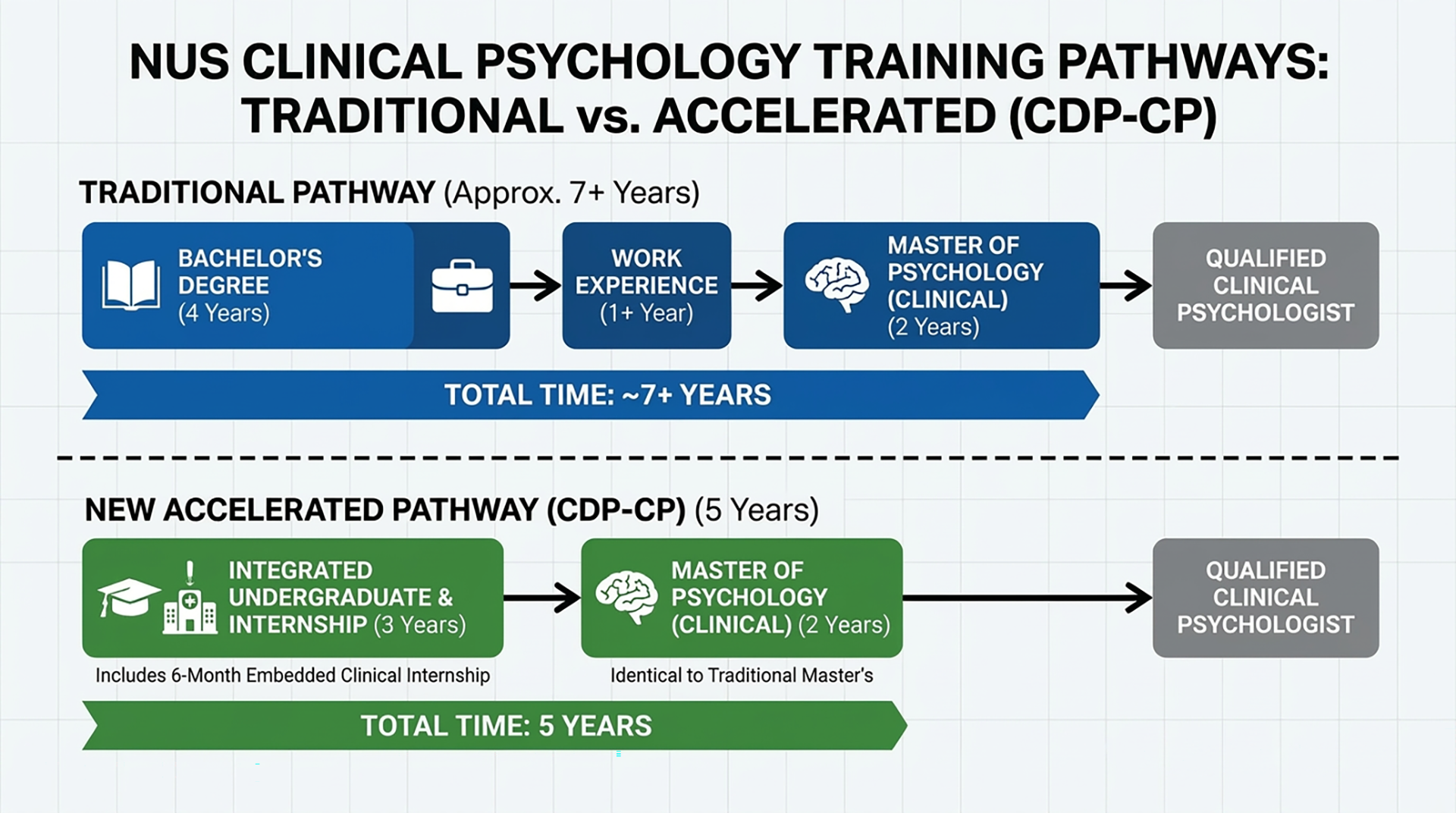
NUS Psychology’s response to this growing demand is an accelerated training pathway that allows eligible undergraduates to qualify as clinical psychologists in five years – instead of the usual seven.
Launched in August 2026, NUS Psychology’s Concurrent Degree Programme in Clinical Psychology (CDP-CP) follows a “three-plus-two” structure: three years of undergraduate study tightly focused on clinical foundations, followed by the same two-year Master of Psychology (Clinical) that all NUS-trained clinical psychologists complete.
This new five-year track does not replace the standalone Master’s programme, which continues to train clinical psychologists who choose to pursue post-graduate studies after gaining relevant work experience. The latter is suitable for those who prefer to explore their interests before committing or who come to clinical psychology later in their careers.
Dr Lohsnah Jeevanandam, Director of the Clinical Psychology programme at the NUS Faculty of Arts and Social Sciences, who led the CDP-CP’s design, together with Dr Matthew Lim and the rest of the clinical psychology faculty, said the two cater to different groups of aspiring clinical psychologists.
“We’re not replacing one pathway with the other,” she said. “Rather, we’re giving more people more options to meet the same growing need.”
From freshman to clinical psychologist
The CDP-CP programme aims to train more clinical psychologists without compromising on the quality of preparation and training.
“There’s a significant national demand for clinical psychologists and we needed to think about how to make the whole pipeline more efficient, so that we can produce more qualified clinical psychologists, faster, without compromising on training,” said Dr Jeevanandam.
Apart from the shorter time needed to complete both degrees, the programme also brings clinical psychology learning and clinical internship into the undergraduate years.
Students who register interest in the CDP-CP get priority access to a focused set of clinical psychology courses, including Introduction to Clinical Psychology, Counselling Psychology and Psychological Assessment, giving them a stronger theoretical grounding earlier than most of their peers. The aim is to better prepare them for the Master’s coursework ahead.
Another key feature is a six-month supervised clinical internship that is also embedded into the undergraduate years — designed to fulfil the relevant work experience typically required for entry into the traditional Master’s programme. During this period, students gain exposure to real client work, conducting basic mental wellness screenings and helping to run group wellness programmes under close supervision.
Together, these enable students to connect psychological theories to the realities of practice early on and develop an early appreciation of the responsibilities involved in supporting people dealing with mental health challenges.
“The internship is a shorter, more concentrated experience than the year of work experience it replaces, but one deliberately designed to give students a meaningful first encounter with clinical practice,” said Dr Jeevanandam, adding that students must still complete the same advanced coursework and further clinical training for their Master’s.
A selective pathway
Entry into the programme is competitive. Of the more than 60 students majoring in Psychology who have registered their interest, only around 10 will ultimately be admitted.
Alongside academic performance, the selection process considers whether students have the aptitude for the demands of clinical psychology, which involves working ethically and responsibly with people facing difficult times.
“We’re talking about developing clinical psychologists who are going to be talking about life and death matters, so we need to make sure we pick the people who have the aptitude for it,” said Dr Jeevanandam.
She added that the Department plans to grow the cohort size as the programme matures, while keeping the same careful selection process.
For prospective students like Wu Tong, a first-year Psychology major who has registered her interest in the CDP-CP, the appeal lies in getting to real clinical work sooner.
“The traditional path works well for many, especially those who want time to gain experience before committing to a Master’s. But for me, I felt ready to commit early… It meant I could move through my training with a clear, structured timeline, and start practising sooner rather than waiting longer to get there,” she said.
Building capabilities across the mental healthcare system
CDP-CP builds on NUS’ longstanding efforts to strengthen Singapore’s mental healthcare workforce.
Since 2010, the NUS Yong Loo Lin School of Medicine has offered the Graduate Diploma in Mental Health (GDMH) in collaboration with the Institute of Mental Health to equip medical professionals with additional knowledge and skills to support people with mental health conditions.
The new NUS Psychology programme extends this work by developing a pipeline of future clinical psychologists to complement the capabilities of professionals already providing mental healthcare.
It also joins a small but growing group of CDP programmes at NUS built around national workforce priorities in areas such as healthcare, public policy, management, environmental management and digital transformation.
By shortening the runway into the profession without shortening the training itself, the CDP-CP is designed to get more qualified clinical psychologists into the workforce sooner — a step towards closing the gap between how many psychologists Singapore needs and how many it has.
More information on the CDP-CP programme can be found here.