When quantum meets AI: NUS brings together international experts to turn frontier technologies into real-world solutions
IntelligenceX 2026 convenes researchers, industry leaders and policymakers to accelerate advances in Quantum × AI, with applications spanning precision medicine, logistics and scientific discovery
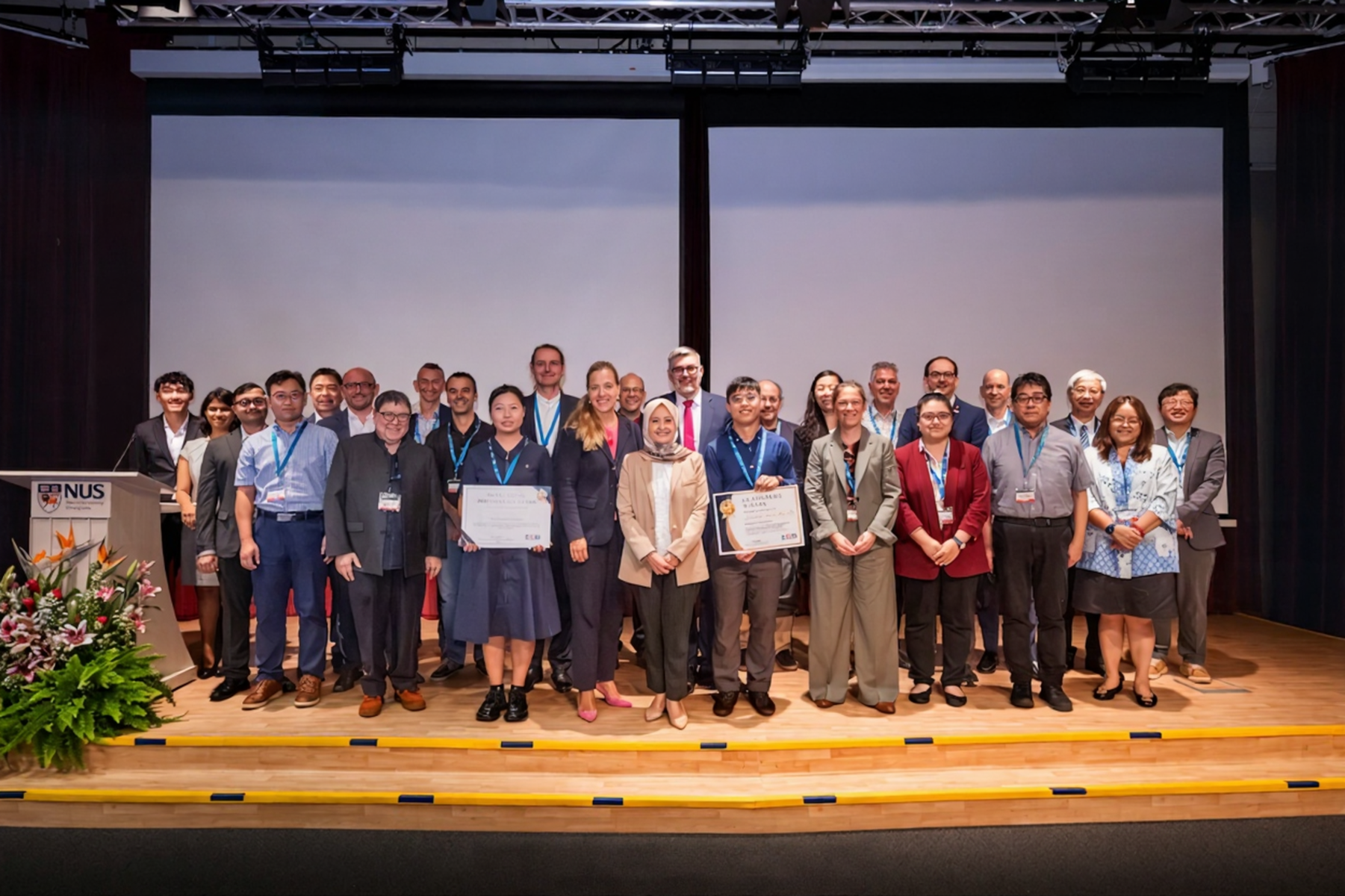
The National University of Singapore (NUS) and the Society of Algorithmic Intelligence (SoAI) is hosting IntelligenceX 2026: Global Quantum × AI Frontier, from 24 to 26 September 2026 at NUS University Town, focused on advances at the intersection of quantum computing and artificial intelligence (AI), and their potential application to real-world challenges. About 300 participants from 22 countries have registered for the three-day conference.
IntelligenceX brings together leading researchers, technologists and industry leaders to explore how quantum computing and AI could open new approaches to challenges in precision medicine, logistics optimisation and scientific discovery. Mdm Rahayu Mahzam, Minister of State for Digital Development and Information, opened the conference as the Guest-of-Honour.
The programme features keynote addresses, panel discussions and hands-on tutorials in agentic AI coding and quantum computing, with participants from leading organisations across Asia, Europe and the United States, including NUS, ETH Zurich, UC Berkeley, D-Wave, IBM and NVIDIA. Technology showcases will demonstrate emerging applications combining quantum and AI technologies across sectors.
“AI has already shown us how quickly a frontier technology can move from research into everyday life. Quantum computing is at a much earlier stage, but the convergence of these technologies gives us an opportunity to think ahead,” said Associate Professor Chen Ying, President of the Society of Algorithmic Intelligence.
She added, “The next frontier will not be defined by a single technology. It will come from combining advances in AI, quantum computing and other forms of high-performance computing with deep scientific and industry knowledge. To prepare for that future, we need to work on three things at the same time: advancing the science, identifying meaningful real-world problems, and developing a new generation of talent able to bridge the two. That is what we want IntelligenceX to help catalyse”. Assoc Prof Chen is from Institute of Operations Research & Analytics, Risk Management Institute and Department of Mathematics, Faculty of Science at NUS.
Global competition puts AI trading strategies to the test
A key highlight of the conference is the International AI Algorithmic Trading Hackathon, which was held in the lead-up to IntelligenceX 2026. The hackathon has attracted 45 teams from Singapore, Australia, China, France, India, Indonesia, Italy, Malaysia, Switzerland and the United States, among others, with participants affiliated with institutions including NUS, Bocconi University, Carnegie Mellon University, EPFL, ETH Zurich, HKUST and New York University.
Using real financial data, the teams applied AI and quantitative methods to develop and test algorithmic trading strategies, challenging participants to go beyond theoretical approaches and apply emerging technologies to address a complex real-world problem. The competition also brought together participants, researchers, industry experts and international partners, providing a platform to identify promising talent, encourage cross-border exchange and seed longer-term research and innovation collaborations.
Team Mushroom emerged as the top-performing team, with meloilz and Team Ember taking second and third place respectively. The three teams received their prizes at the IntelligenceX Opening Ceremony.
Taking Quantum × AI from research towards application
The conference builds on a broader NUS effort to move Quantum × AI from research towards practical adoption. Central to this effort is the NUS Integrated Quantum & AI Computing Consortium, launched in January 2026 to bring together researchers, industry partners and government agencies to identify and develop real-world applications at the intersection of quantum computing and AI.
The Consortium now includes six members – PCS Security, Singapore Airlines, STTGDC, ST Engineering, the Home Team Science and Technology Agency (HTX) and the Digital and Intelligence Service (DIS) – working together to build a pipeline of quantum- and AI-ready talent, and explore potential applications of the technologies. Members tap NUS' multidisciplinary expertise and participate in hands-on workshops using open-source quantum computing tools to explore potential use cases. The Consortium is also developing an executive quantum-readiness programme to help industry leaders assess how their organisations can prepare for the adoption of quantum and AI technologies.
IntelligenceX 2026 is designed to go beyond a single event, creating sustained connections between researchers, industry and government that can drive long-term collaboration in quantum computing and AI. The full conference programme is available at https://www.soc-ai.org/events/intelligencex-2026.