Supercharging education: Building AI tools to support teaching and learning at NUS

In the age of Artificial Intelligence (AI), human connection and collaboration remain paramount. Staff from NUS Information Technology (NUS IT), the Centre for Teaching, Learning and Technology (CTLT) and NUS faculties have been working together to develop practical AI-enabled tools that draw on different forms of expertise. Educators contribute their understanding of students, disciplinary contexts and intended learning outcomes; CTLT’s academic developers and education technologists bring learning design expertise; and NUS IT provides the technical knowledge and expertise to develop tools for wider use.
“Building an AI solution for education is not just about whether technology can do it, but whether we should. The tools and solutions we build must support learning objectives and elevate the student experience,” said NUS IT Associate Director Ng Jun Da, who is involved in developing all seven tools.
This principle keeps the team anchored to a human-centred approach: AI should support the people involved in education, while preserving the thinking, interaction and judgement through which learning occurs.
Three of the tools are currently being piloted in NUS courses.
Brainstorm: Getting students past the blank page
Brainstorm uses Socratic questioning to help students move past blank-page syndrome in the early stages of projects. By prompting them to examine assumptions, consider alternatives and refine their conclusions, Brainstorm encourages independent analytical thinking rather than providing ready-made answers.
Getting the balance took careful work. “Push too far and the tool becomes hard work, so students stop using it. Lean the other way and it hands over answers, producing cognitive offloading,” said Dr Rajesh Panicker, who leads the Learning and Technology pillar at CTLT.
Faculty perspective proved essential. Dr Panicker noted that having teaching staff on the team helped the group think through how students would actually use the tool, what instructors realistically have time for, and where features that looked good on paper might create friction in practice.
This tool is being piloted in three courses offered by the NUS Faculty of Science and NUS Business School. In LSM4259 Evolutionary Genetics of Reproduction, Brainstorm is used to support students in topic selection and early hypothesis formation, while in FST4104 Food Product Innovation, it helps students develop concepts for a new food-product launch from an assignment brief. In FSP4003 Field Service Project, Brainstorm supports student teams working through ideas for a real-world company problem.
Verify: Teaching students to think critically about AI
Verify presents students with multiple plausible AI-generated responses, which differ in accuracy, reasoning, style or tone, some containing deliberate errors. Students must decide what is credible and well-supported, and explain their reasoning.
An early pilot surfaced an important lesson about framing. The team found that the tool’s original name — The Untrustworthy Assistant — risked priming students to distrust AI rather than evaluate it critically. Hence, they used simpler, action-oriented names instead. CTLT Senior Associate Director Narayanan Shyam, who led Verify from concept to pilot, reflected, “It was a valuable reminder that the way we frame educational technology can be just as important as the technology itself.”
Testing tools in authentic learning contexts helped the team identify and address unintended effects, underscoring the value of bringing pedagogical and technical perspectives together.
At the NUS Faculty of Arts and Social Sciences, PL1101E Introduction to Psychology is piloting Verify. During the course, students compare several AI-generated responses, select the strongest, and explain their reasoning. These exercises can surface fabricated citations, weak reasoning, or disciplinary misconceptions for students to critique and correct.
Engage: Making classroom discussion visible
Engage supports active learning by capturing classroom discussions and generating reports that help instructors identify key themes and patterns in the discussion, as well as questions or ideas that may warrant further attention.
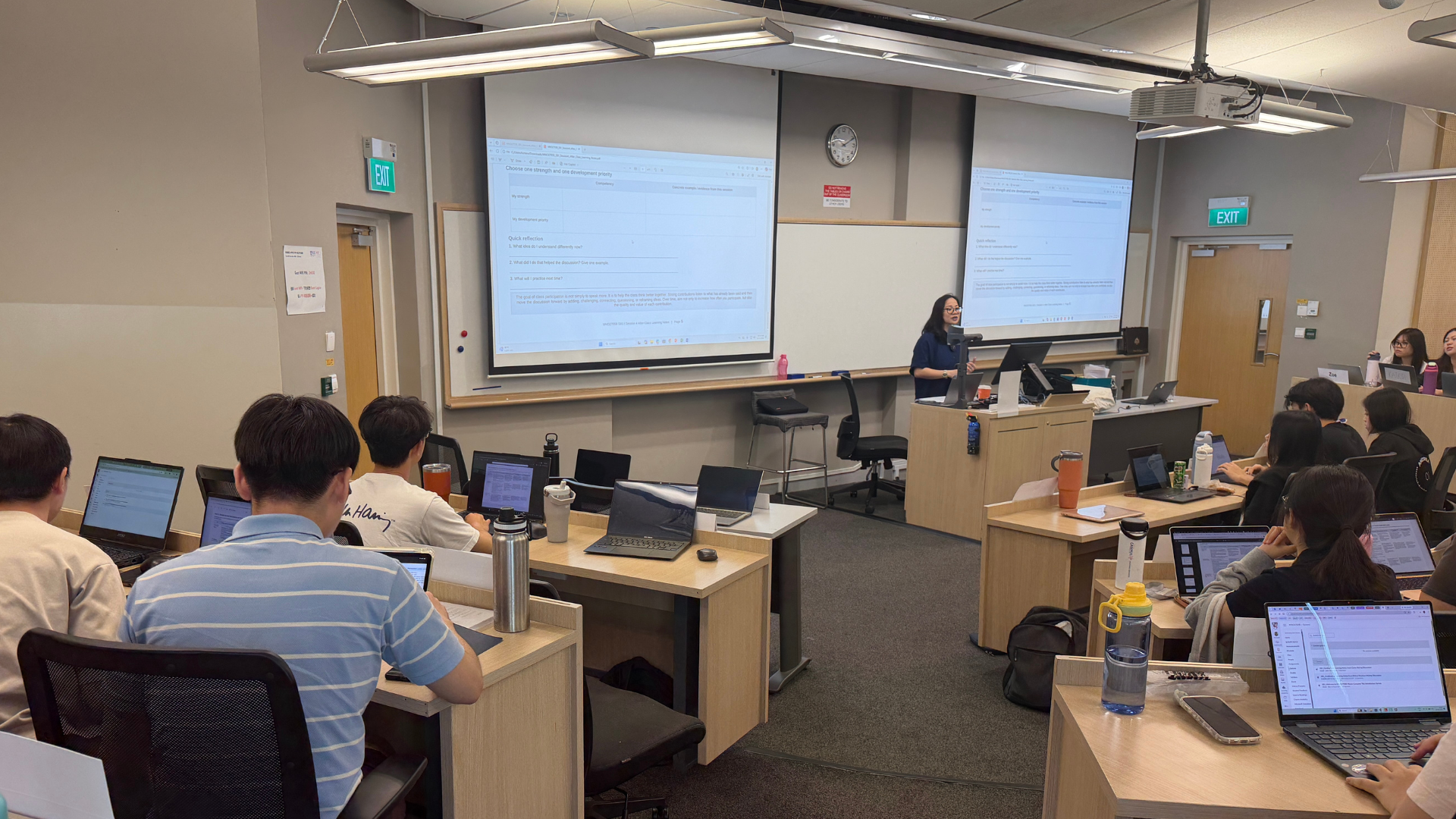
“It turns classroom discussion into a resource that both instructors and students can revisit, learn from, and use to improve future learning experiences,” said NUS Business School’s Dr Noriko Tan, who piloted Engage across four class sessions.
Discussion-based activities are among the richest parts of a class, yet their value can fade quickly. “Once the session ends, both students and instructors may remember only fragments of the conversation. With Engage, I can revisit the discussion, identify important ideas that emerged, and reflect on how I facilitated the conversation.” Engage makes those conversations recoverable and reflective.
Engage is also being piloted in LSM4259 Evolutionary Genetics of Reproduction to capture presentation Questions & Answers to identify follow-up needs, and in SC4218 Religions, Secularity, Post-Secularity to document seminar discussion and help surface gaps or underdeveloped arguments.
Developing these tools has never been a one-person job. It takes educators, academic developers, education technologists and technology specialists working together, asking not just what AI can do, but what will genuinely support learning in practice.