What the Straits of Malacca and Singapore can teach the world about international cooperation
NUS Centre for International Law experts and leading maritime scholars examine key lessons on how international law and diplomacy have kept the Straits open in their new book.
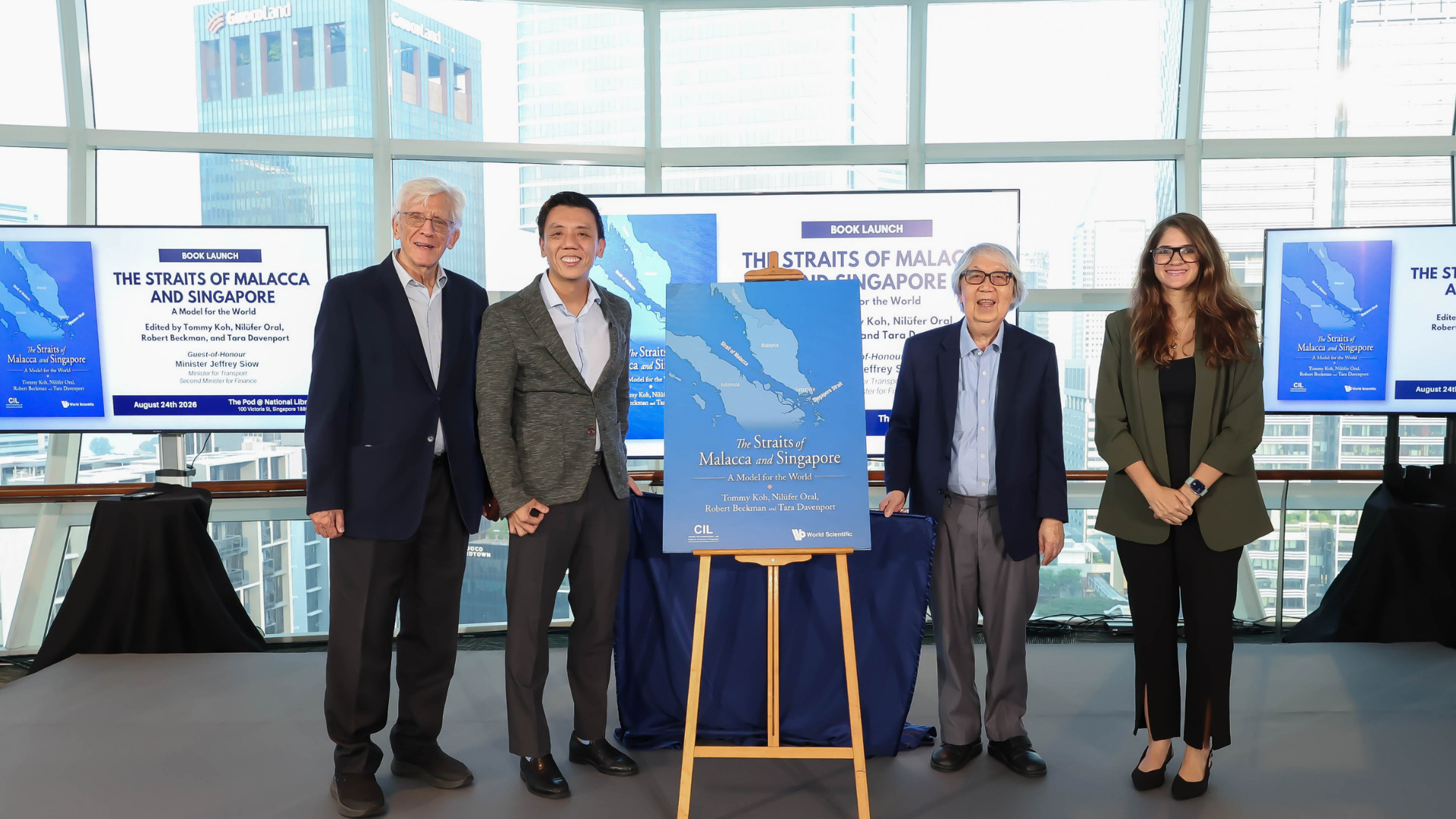
The Straits of Malacca and Singapore are prime examples of how close collaboration among countries in managing the waterways can help ensure smooth trade flows for the nations and vessels that rely on this critical shipping route. Despite being bordered by three countries — Indonesia, Malaysia and Singapore — the Straits have been a beacon of multilateral cooperation.
This rare partnership is the focus of a new book, The Straits of Malacca and Singapore: A Model for the World, which brings together historical, legal, maritime and strategic perspectives from experts at the NUS Centre for International Law (CIL) and leading maritime scholars.
Launched on 24 August 2026, the book builds on CIL’s longstanding research into ocean law, maritime governance and shipping, reflecting the Centre’s broader role in connecting rigorous legal research with real-world policy challenges facing Singapore, Asia and the international community.
“We are the only straits in the world which have what is called a Cooperative Mechanism,” said Professor Tommy Koh, veteran diplomat and Chairman of the CIL International Advisory Panel, on the sidelines of the launch.
Launched by the three countries in 2007, the Cooperative Mechanism is a framework to enhance navigational safety and environmental protection in the Straits of Malacca and Singapore. It brings together other countries that use the Straits, the shipping industry and other stakeholders to voluntarily share information and resources to keep the Straits safe and open to shipping.
Today, the Straits of Malacca and Singapore are among the busiest waterways in the world, through which nearly 30 per cent of global trade passes every year.
Prof Koh edited the book together with three leading maritime scholars: Dr Nilufer Oral, Director of CIL; Professor Robert Beckman, NUS Emeritus Professor and Senior Advisor of CIL’s Ocean Law programme; and Dr Tara Davenport, the programme’s co-head.
A vision come true
The book brings to life a vision that Prof Koh has held for years: to curate the historical, legal, maritime and strategic aspects of the Straits in one comprehensive account.
It was an idea that took root when he led Singapore’s delegation at the Third United Nations Conference on the Law of the Sea from 1973 to 1982. As the conference’s president in 1982, he guided the adoption of the UN Convention on the Law of the Sea (UNCLOS), a landmark treaty that remains a cornerstone of maritime law today and ensures free global trade through international waters.
“The experience of Singapore, Malaysia and Indonesia demonstrates how countries with different interests and sovereignty concerns can work together to manage a shared and strategically vital waterway,” he said.
But the cooperation that sustains the Straits of Malacca and Singapore goes back many years, predating the adoption of UNCLOS.
After World War II, the coastal states pushed to extend territorial seas from three to 12 nautical miles. This would have closed the Straits of Malacca and Singapore — a risk that Indonesia, Malaysia and Singapore recognised. “The three states decided very early they had to do something about this,” said Prof Beckman.
This led to the formation of the Tripartite Technical Experts Group in 1976, the main coordinating body of the three littoral states, which in turn paved the way for the Cooperative Mechanism in 2007.
“All three states have an interest in ensuring there’s safety of navigation so that there are no collisions, that pollution of the marine environment is minimised, and there are funds in case there’s an oil spill,” added Prof Beckman.
“In that sense, the three states have a completely common interest, not a divergent interest.”
Lessons for other waterways
Such cooperation is in stark contrast to the ongoing crisis in the Strait of Hormuz, where commercial shipping has been severely disrupted by the US-Iran conflict.
The book, said Prof Koh, is a timely reminder of the importance of diplomatic trust to keep vital sea lanes open for trade.
Its scope, which spans history, international legal regime, hydrography and commercial relevance, caters to a range of readers, from lawyers and policymakers to maritime practitioners.
Because many of these issues had previously been discussed in isolation, the book fills an important gap in understanding the Straits, said Ms Amanda Wee, a Research Assistant at CIL’s Ocean Law and Policy Programme who coordinated the book’s development.
“Alongside the global significance of the Straits in today’s volatile world is the lack of a book comprehensively examining the Straits of Malacca and Singapore from different disciplines in existing literature,” she noted.
By bringing together perspectives that have often been examined separately, the book ultimately aims to provide a more comprehensive account of the management of the Straits and the resulting lessons it offers policymakers, practitioners and scholars in Singapore and beyond.
The book, published by World Scientific Publishing is available at all major bookstores and online.